Five chapters and a prelude bring forth American voices in a new way; a way that draws out from the diction and rhythm and word choice of that Good Book, the King James Bible, and, in particular, its rendition of the Old Testament, the unusual mixture of the literary and colloquial that defines American literature over the last two centuries. Robert Alter's Pen of Iron: American Prose and the King James Bible is a history of linguistic dynamics, from Moby Dick and Lincoln's speeches through to The Road and Gilead, and I can think of nothing like it out there in the reading world. I have read reviews suggesting this is an academic book of interest to specialists; do not believe those who would so limit it. If you read Faulkner and Melville and Hemingway, you should read Alter. You must read Alter. Really.
Alter's chapter on Moby Dick is truly and particularly brilliant, and one of the best things written on The Whale in the last half-century. He writes with the insights of a translator, yet writes of his own language and the subtle structures imported into it from the Hebrew in Elizabethan times and then again from the Elizabethan to the American, and traces the millenia for us in Melville's taut and oppositional prose. He finds Biblical poetry nestled among the many voices of the Great Whale, and carefully teases it out, comparing it to the other strands in Melville's voice, and highlighting its interaction with Melville's always deeper meanings.
Alter gets Melville's voice, he truly digs it, and he lets its light shine in a way that will enrich every reader's experience. His chapter on Faulkner is merely very good, but the chapter on Bellow and the discussion of Lincoln in the preface each challenge those Melvillian peaks.
If you are going to read contemporary literary criticism, put Alter on top of your list. I can think of only one other living American critic I would put on his level, and her focus is not the American corpus. (
Showing posts with label Bible. Show all posts
Showing posts with label Bible. Show all posts
Saturday, March 10, 2012

Saturday, February 11, 2012
The Song of the Typhoon: Second Verse
We have heard the Typhoon sing in our first verse. We are on the quarterdeck, where Starbuck would turn the ship toward home, but Ahab, "Old Thunder", has appeared to sing with the storm. At this very moment, the action pauses briefly, and we have a short discussion on lighting rods. Rods have been fixed to the masts, but they attach to chains which must be thrown over-board to ground the boat. These chains, on the Pequod, have not been thrown overboard.
Starbuck, seeing mad Ahab lit up by lightning, yells to the crew to drop the chains. To this, Ahab cries to let them be. Ahab is looking to wage an old war here, not a modern one; the ancient Ahab is engaged in a primal quest. In the prior chapter, he crushed his Quadrant, choosing to steer by the old arts; here, he refuses the lightning rods. He is pulling the Pequod into an id of time.
And at this moment, before any chains have gone over, the flames appear: St. Elmo's fire. The boat's masts mystically light up, and now Melville weaves magic. Watch the two pages after the fire lights. There is so much here.
The crew falls silent, free of oaths; Melville notes that while for sailors oaths are but a common part of speech, he has
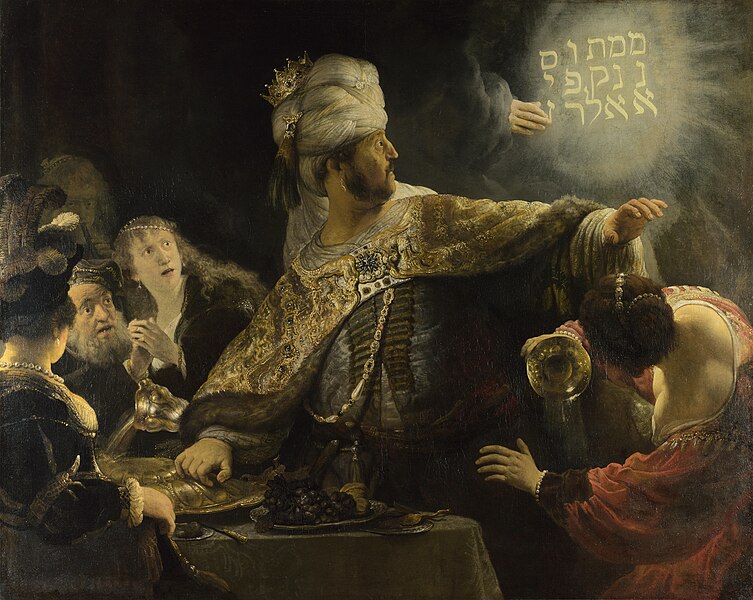
seldom heard a common oath when God's burning finger has been laid on the ship; when His "Menne, Mene, Tekel, Upharsin" has been woven into the shrouds and the cordage.The phrase is from the book of Daniel, which reads:
And this is the inscription that was written: MENE, MENE, TEKEL, UPHARSIN.In Daniel, God writes these words on the wall at a banquet at Belshazzar's Feast, where the nobles are sacreligiously toasting to other gods from Jewish sacrimental vessels. Note that Melville, or Ishmael, seems to have seen God send this message to whalers on more than one occassion. The art shows Rembrandt's depiction of the "writing on the wall" scene in Daniel, from the National Gallery.
This is the interpretation of each word. MENE: God has numbered your kingdom, and finished it;
TEKEL: You have been weighed in the balances, and found wanting;
PERES: Your kingdom has been divided, and given to the Medes and Persians.
During the silence, Queequeg's tatoos light up "like Satanic blue flames"; as the corposcants die, the Pequod is "wrapped in a pall". Finally, the silence is broken with Starbuck looking to Stubb for his read of the meaning of the corposcents, and while Stubb tries to read them as a good omen (as lit up spermacetti candles), Stubb quickly pleads for mercy on their souls as they light up once again. A moment of very dark humor at Stubb's expense.
At this point, Fedallah is lit up fitting out Ahab for the next coming strange ceremony; stepping on Fedallah, beside the Doubloon, Ahab gives a speech to the storm and the crew, telling of his prior wounding by lighting on these seas, his prior dismasting, when he "as a Persian once did worship". He calls to the fire, "Oh, thou clear spirit, of thy fire thou madest me, and like a true child of fire, I breathe it back to thee." This is the third great sermon, preached from on high, of the book, following Father Mapple's sermon in Nantucket and The Reverend Cook's sermon to the sharks. It is worthy of a close reading and comparison, though I will not do so now, since we are looking for a broad overview of this critical chapter.
Now, as you might imagine, Franklin with his Osiris myth has a field day with this chapter. There is no shortage of references that fit the myth including the anticipation of a pall for Ahab. However, other commentators, with different favorite myths, also see much in this chapter. Myths come together. In particular, many have focused on the Zoroastrian theme that sits right on the surface obvious to all: from the "Mene, Mene, Tekel, Upharsin" reference to Fedallah's role as Ahab's alter-boy and footstool to Ahab's statement that he "as a Persian once did worship". You will find fire imagery throughout this book, and fire is a key symbol in Zoroastrianism. The sun is a character all its own in Moby-Dick, whether beating down on poor Pip or floating in the upper half of the Doubloon. Here in "The Candles" is where you will best gain insight into the role of fire. Watch closely; it is a mighty force, and closely associated with Ahab. In Christian mythology, first is most often associated with hell, but in Moby-Dick fire does not play so clear or simple a role.
Ahab's speech is answered by yet more lightning and flame, and, in particular, the corposcents now light up his harpoon, which sits on his boat, just as it has lit up the masts. The lighting of the harpoon is magnificent and awe-inspiring. The crew is completely panic stricken. References to "The Forge" and earlier chapters involving fire abound. And, at this critical moment, Starbuck knows what he must do: he tells Ahab, in no uncertain terms, that God is against him and it is time to set the sail for home or face God's wrath. As the crew comically prepares to set sails that have been shredded to rags, Ahab reminds them their oaths to hunt the Whale are binding, as is his. We end the chapter with all in terror, with Starbuck and Ahab opposed, and with the crew in dismay at Ahab's orders.
In unpacking this chapter, I would focus you on two truly exquisite strands, recognizing there are others: first, the pivot to a fast-paced action-adventure and the movement into the final part of the book is a masterful exercise in writerly craftsmenship; and, second, the way in which many different mythological strands are brought together is a phenomenal set-up for our grand finale, with first the drama among the sailors and then the chase of the White Whale. The Book of Daniel melds both Judaic/Old Testament and Persian/Parsee mythological streams; the use of fire sets up an opposition of Parsee/Pagan and Christian themes (watch all the pagans in this chapter: they each receive a mention); the Typhoon captures it all in the ancient Egyptian myth. Suddenly, Ahab's central role in each different mythology seems to be coming together, even though the role he plays in each does not seem to allign. Is this song contrapuntal? Is Ahab simultaneoulsy a hero of a Parsee, a God to the Egyptians, and a Blasphemous Rebel to the Jews?
Sunday, December 11, 2011
Some reading before reading...
One great thing to read if you have 5 minutes in this period before the actual reading of Moby Dick begins is the Biblical story of Jonah. It is four spare verses without undue drama or color and a very simple story, but will be echoed throughout Moby's hundred and thirty-five chapters. Most of us already know the story in embellished form (save perhaps the fourth verse), and it's good to remember the purity and spareness of the four simple verses.

This is a detail from a third to fifth century coptic wall-hanging in the Louvre ((c) Louvre, noncommercial use permitted). The story is not just old, but has been retold wherever sailors gather. Often, however, without the ending, which is both the point and a bit of a curve ball for many.

This is a detail from a third to fifth century coptic wall-hanging in the Louvre ((c) Louvre, noncommercial use permitted). The story is not just old, but has been retold wherever sailors gather. Often, however, without the ending, which is both the point and a bit of a curve ball for many.
Subscribe to:
Posts (Atom)