Showing posts with label Bruce Franklin. Show all posts

Saturday, February 11, 2012

The Song of the Typhoon: Second Verse


We have heard the Typhoon sing in our first verse. We are on the quarterdeck, where Starbuck would turn the ship toward home, but Ahab, "Old Thunder", has appeared to sing with the storm. At this very moment, the action pauses briefly, and we have a short discussion on lighting rods. Rods have been fixed to the masts, but they attach to chains which must be thrown over-board to ground the boat. These chains, on the Pequod, have not been thrown overboard.

Starbuck, seeing mad Ahab lit up by lightning, yells to the crew to drop the chains. To this, Ahab cries to let them be. Ahab is looking to wage an old war here, not a modern one; the ancient Ahab is engaged in a primal quest. In the prior chapter, he crushed his Quadrant, choosing to steer by the old arts; here, he refuses the lightning rods. He is pulling the Pequod into an id of time.

And at this moment, before any chains have gone over, the flames appear: St. Elmo's fire. The boat's masts mystically light up, and now Melville weaves magic. Watch the two pages after the fire lights. There is so much here.

The crew falls silent, free of oaths; Melville notes that while for sailors oaths are but a common part of speech, he has
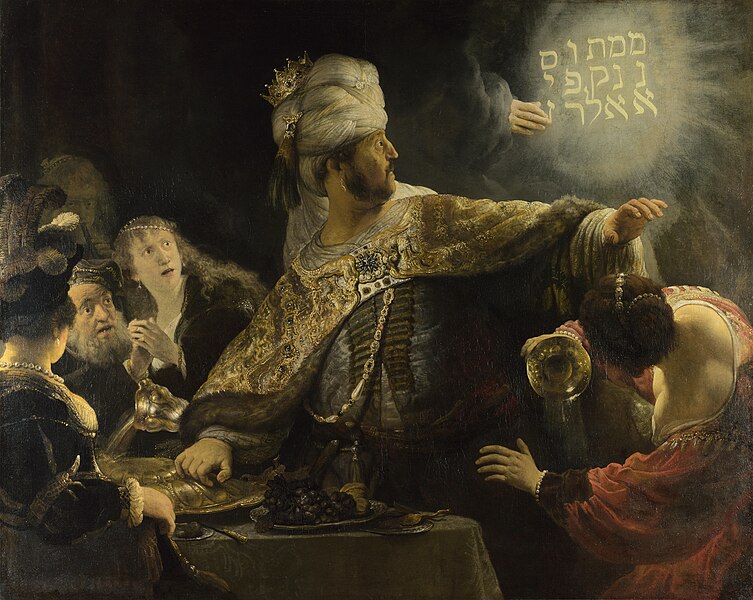
seldom heard a common oath when God's burning finger has been laid on the ship; when His "Menne, Mene, Tekel, Upharsin" has been woven into the shrouds and the cordage.
The phrase is from the book of Daniel, which reads:
And this is the inscription that was written: MENE, MENE, TEKEL, UPHARSIN.
This is the interpretation of each word. MENE: God has numbered your kingdom, and finished it;
TEKEL: You have been weighed in the balances, and found wanting;
PERES: Your kingdom has been divided, and given to the Medes and Persians.
In Daniel, God writes these words on the wall at a banquet at Belshazzar's Feast, where the nobles are sacreligiously toasting to other gods from Jewish sacrimental vessels. Note that Melville, or Ishmael, seems to have seen God send this message to whalers on more than one occassion. The art shows Rembrandt's depiction of the "writing on the wall" scene in Daniel, from the National Gallery.

During the silence, Queequeg's tatoos light up "like Satanic blue flames"; as the corposcants die, the Pequod is "wrapped in a pall". Finally, the silence is broken with Starbuck looking to Stubb for his read of the meaning of the corposcents, and while Stubb tries to read them as a good omen (as lit up spermacetti candles), Stubb quickly pleads for mercy on their souls as they light up once again. A moment of very dark humor at Stubb's expense.

At this point, Fedallah is lit up fitting out Ahab for the next coming strange ceremony; stepping on Fedallah, beside the Doubloon, Ahab gives a speech to the storm and the crew, telling of his prior wounding by lighting on these seas, his prior dismasting, when he "as a Persian once did worship". He calls to the fire, "Oh, thou clear spirit, of thy fire thou madest me, and like a true child of fire, I breathe it back to thee." This is the third great sermon, preached from on high, of the book, following Father Mapple's sermon in Nantucket and The Reverend Cook's sermon to the sharks. It is worthy of a close reading and comparison, though I will not do so now, since we are looking for a broad overview of this critical chapter.

Now, as you might imagine, Franklin with his Osiris myth has a field day with this chapter. There is no shortage of references that fit the myth including the anticipation of a pall for Ahab. However, other commentators, with different favorite myths, also see much in this chapter. Myths come together. In particular, many have focused on the Zoroastrian theme that sits right on the surface obvious to all: from the "Mene, Mene, Tekel, Upharsin" reference to Fedallah's role as Ahab's alter-boy and footstool to Ahab's statement that he "as a Persian once did worship". You will find fire imagery throughout this book, and fire is a key symbol in Zoroastrianism. The sun is a character all its own in Moby-Dick, whether beating down on poor Pip or floating in the upper half of the Doubloon. Here in "The Candles" is where you will best gain insight into the role of fire. Watch closely; it is a mighty force, and closely associated with Ahab. In Christian mythology, first is most often associated with hell, but in Moby-Dick fire does not play so clear or simple a role.

Ahab's speech is answered by yet more lightning and flame, and, in particular, the corposcents now light up his harpoon, which sits on his boat, just as it has lit up the masts. The lighting of the harpoon is magnificent and awe-inspiring. The crew is completely panic stricken. References to "The Forge" and earlier chapters involving fire abound. And, at this critical moment, Starbuck knows what he must do: he tells Ahab, in no uncertain terms, that God is against him and it is time to set the sail for home or face God's wrath. As the crew comically prepares to set sails that have been shredded to rags, Ahab reminds them their oaths to hunt the Whale are binding, as is his. We end the chapter with all in terror, with Starbuck and Ahab opposed, and with the crew in dismay at Ahab's orders.

In unpacking this chapter, I would focus you on two truly exquisite strands, recognizing there are others: first, the pivot to a fast-paced action-adventure and the movement into the final part of the book is a masterful exercise in writerly craftsmenship; and, second, the way in which many different mythological strands are brought together is a phenomenal set-up for our grand finale, with first the drama among the sailors and then the chase of the White Whale. The Book of Daniel melds both Judaic/Old Testament and Persian/Parsee mythological streams; the use of fire sets up an opposition of Parsee/Pagan and Christian themes (watch all the pagans in this chapter: they each receive a mention); the Typhoon captures it all in the ancient Egyptian myth. Suddenly, Ahab's central role in each different mythology seems to be coming together, even though the role he plays in each does not seem to allign. Is this song contrapuntal? Is Ahab simultaneoulsy a hero of a Parsee, a God to the Egyptians, and a Blasphemous Rebel to the Jews?

Tuesday, January 10, 2012

Primordial Divinity


In the chapter "the Advocate", Melville writes:

I freely assert, that the cosmopolite philosopher cannot, for his life, point out one single peaceful influence, which within the last sixty years has operated more potentially upon the whole broad world, taken in one aggregate, than the high and mighty business of whaling. One way and another, it has begotten events so remarkable in themselves, and so continuously momentous in their sequential issues, that whaling may well be regarded as that Egyptian mother, who bore offspring themselves pregnant from her womb. It would be a hopeless, endless task to catalogue all these things.


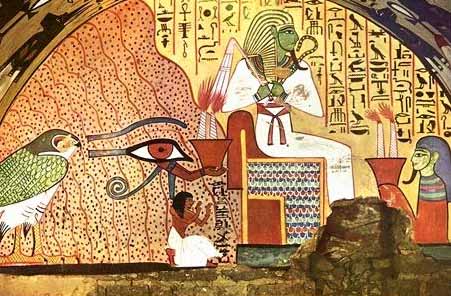
The reference to the "Egyptian mother" is a reference to the myth of Isis and Osiris. Osiris, Isis' twin brother, impregnantes her in the womb of their mother, Nut. This is not the last mention or reference to Egypt or Egyptians. In just a few pages, Starbucks will be described as having the strength of a "revivified Egyptian"; later, Ahab will be described as having an "Egyptian chest", and a whale head will be described in a chapter called "The Sphinx".

Bruce Franklin, in The Wake of the Gods, argued that the "central myth" around which Moby-Dick was constructed was the myth of Osiris, a myth that was chosen in part for it's "unfathomable antiquity", prior to the Hebrew scriptures and to all the known scriptures of the Mediteranean world. For Franklin, Egypt is the "birthplace of the Gods" and Melville's use of Egyptian themes and images is intended to root the book in the most primordial of all worlds.

Here is Franklin's summary of the core of Osiris myth that Melville used, involving Osiris' battles with Typhon (as opposed to the Isis story or some other myths involving Osiris) which he notes is drawn from several somewhat divergent strands in Plutarch and in Thomas Maurice's Indian Antiquities:

Osiris is a priest-king-god who sails the world in a ship that later becomes the consellation Argo. He hunts Typhon, who is usually represented by some kind of aquatic monster and who symbolizes the ocean and all in nature that is malignant to man. Once a year, Typhon dismembers Osiris. When this happens -- the date is variously given as the autumnal equinox, the winter solstice, and the period in between -- Osiris disappears for a certain length of time, which is also variously given. During this absence from earth, he rules the infernal regions and a ship sails the world bearing his coffin. During this time, also, his phallus is missing and the land lies infertile. In a vernal phallic ritual, Osiris is healed and the fertility of the land is restored. His dismemberment in the fall or winter symbolizes the seasonal disaster in nature. The seasonal ressurection of the sun causes, symbolizes, or is symbolized by his resurrection.


I will not try to provide you with all the many details, analyses or wonderful turns of phrases offered by Franklin; there are some deep and convincing discussions (the comparison of Ahab's dismemberment and recession to Osiris), some "Oh My God!" revelations (Osiris' symbols were the hawk, the coffin and the phallus!), and highly questionable assumptions (as discussed in an earlier post, that humorous discussions of myths should be discounted in importance), all melded together with a close reading of Melville's own words. Franklin approaches the book with a fascinating methodology, steeping himself, over an extended time, in the comparative mythology of Melville's own time, giving short shrift to the more modern, and trying to resurrect himself as something of a 19th century comparative mythologist.

For us, armed with Franklin's description of the myth, here at the first mention of Egypt, it is time to start looking for the small bits of Egyptian bird seed sprinkled about the book and seeing where they lead. My own view is that the Osiris myth is "A" very important part of this world Melville has created, but by no means "THE" central mythology. There's more afoot! But I want to inject Osiris into the discussion now, so we can visit the myth again in the coming pages, and see what we find.

Oh, and do note closely, that while Osiris is undergoing the death phase of his cycle of death and resurrection, he rules over the underworld.

Friday, December 16, 2011

The Revival

The Melville Revival has become an iconic event in American literary history, and I won't even try to discuss all the debates over it that I have read (or, at the very least, perused). Suffice it to say that Melville went from being a minor mention (how minor to be debated) in America's literary history to a grand central figure of the 19th century by the mid-1920s, and that this revival of interest in him began slowly and surreptitiously somewhere in, depending on who you talk to, the parlors of Paris, academies by rivers, or the hotel lounges and walk-ups of New York in the teens. The telling and retelling and examining and rexamining and debunking and rebunking of the elements of the story is an important part of today's Melville industry. But the immediate impact of the revival, besides the development of more contemporary forms of torment for young students to replace the dwindling interest in beating them repeatedly with Latin copies of the Aeneid, was a raft of fairly interesting books. Let's look at a few.

Raymond Weaver is always mentioned first. His 1921 biography of Melville, Herman Melville: Mariner and Mystic, is still in print, and still reads well. Even if most of the biographical details are subject to debate and questioning, the book has held up well. Much of Weaver's detail can be glossed or expanded or the basis of the his opinions and biases questioned, but he generally did his work well and the core narrative remains fluent, interesting and useful. Weaver was also responsible for the first publication of Billy Budd in 1924 as part of an edition of the Complete Works of Herman Melville put out by the London publisher Constable. Weaver, however much he desired to do a complete biography and collect the complete works, was completely entralled by Moby Dick and less overwhelmed by Melville's other work; indeed, his narration of Melville's tragic decline has been persistent, and we are still reviving Melville's later works.

Another work that helped secure the broader reputation of Melville and Moby Dick was D.H. Lawrence's Studies in Classic American Literature, also still in print and likely to be Lawrence's most lasting and significant contribution to literature. Lawrence is quite animated in the book, and includes an interesting chapter on Typee and Omoo as well as one on Moby Dick. Lawrence begins another grand tradition: that of Melville as inspiration for critical works with no small literary virtue of their own, a tradition that reaches its height in Charles Olson's eclectic Call Me Ishmael, where Olson's critical discussion spontaneously bursts out in verse in several places. It is worth a little quote from Lawrence to see how Melville inspires him:

But it is a great book, a very great book, the greatest book of the sea ever written. It moves awe in the soul.

The terrible fatality.

Fatality.

Doom.

Doom! Doom! Doom! Something seems to whisper it in the very dark trees of America. Doom!

Doom of what?

Doom of our white day. We are doomed, doomed. And the doom is in America. The doom of our white day.

Ah, well, if my day is doomed, and I am doomed with my day, it is something greater than I which dooms me, so I accept my doom as a sign of the greatness which is more than I am.

Melville knew. He knew his race was doomed. His white soul, doomed. His great white epoch doomed. Himself, doomed. The idealist, doomed: The spirit, doomed.

The reversion. 'Not so much bound to any haven ahead, as rushing from all havens astern.'

That great horror of ours! It is our civilization rushing from all havens astern.

The last ghastly hunt. The White Whale.

What then is Moby Dick? He is the deepest blood-being of the white race; he is our deepest blood-nature.

Such Marvelous, Beautiful, Strange Bombast! Lawrence outdoes himself, and part of the fun of a good Whale obsession is seeing some of the literary figures and critics who go virtually mad with glee at this odd book.

Two other books from the 1920s revival worthy of mention are Carl Van Doren's The American Novel early in the decade and Lewis Mumford's Herman Melville: A Study of His Life and Vision late in the decade.

The revival continued to gather steam, slowly extending to Melville's other works; in 1945 Robert Penn Warren somewhat carefully and reluctantly recognized a kernal of genius in Melville's poetry in his essay "Melville the Poet", still available in his New and Selected Essays; Elizabeth Foster rescued The Confidence-Man: His Masquerade in the late forties and early fifties, ultimately coming out with a new edition in 1954 from Hendricks House as part of a broader Melville publishing project; and Bruce Franklin elevated Mardi to a central place in the Melville pantheon in his 1963 The Wake of the Gods. Beginning in the 1960s, the Northwestern-Newberry complete scholarly edition begins coming out at a laconic pace, providing the foundations for the vibrant Melville industry of today. Indeed, fetishizing Melville's more obscure work has become so fashionable that Harold Bloom even added Clarel to his The Western Canon.

Monday, December 5, 2011

Of useful false dichotomies

Critics seem to split into two camps: those who read Moby Dick as part of the Western tragic tradition, a camp that notably includes Charles Olson and Hershal Parker, and those that read Moby Dick as part of a legendary epic tradition, a camp whose strongest voice is Bruce Franklin, the student of the group's founder, Yvor Winters. These camps do love to spar.

The first camp begins with Shakespeare, and when you begin there, really, how far do you ever need to travel? They generally see Melville (and his friend, Hawthorne) facing a fundamental problem: how do you write tragedy, which is dependent on having grand characters whose fall carries weight and so fitting for societies filled with nobles and royals, in a Jacksonian leveling democracy? I will confess, I find it baffling how this could be a problem. One need only look to General Jackson for a grander-than-life figure with tragic implications in a Jacksonian democracy: there is an Ahabian cast to the fellow. Moreover, Melville lived in a world where romantics agag at the sublimity of the American frontier coexisted with practical settlers continually afear of the endless dangers there. And, as if we need yet more tragedy for a young democracy to handle, he wrote during the decade when slavery was showing its local obstinancy even as much of the rest of the world had retreated from it a generation or two before, and the civil war loomed on the horizon, increasingly undeniable and as grand a tragedy as could be imagined. It doesn't seem hard to find tragic subjects in that place and time, though, still, it seems not just a noble but a very useful and practical goal to fashion a true American tragedy in such a world, a tragedy which might even provide a bit of a survival manual for such a world. This camp of critics has a particular fascination with Ahab and his drama; for them the Whale seems vastly less of a character than Ahab, a mere foil rather than a subject of its own. Ahab, however, is the incarnation of every Shakespearian tragic hero, from Lear and Cesar and Anthony right on, with several of the historical figures thrown in.

The second camp seeks all over the edges of the watery parts of the globe for answers to where the inspiration came for the epic legend that is Moby Dick, and almost seems to merge in the Whale all the shadowy looming figures of the world's legends. For this camp, the Whale is as much at the center of the book as Ahab; the book has two demi-gods entwined in a divine and fatal minuette. They find answers from the Ancients of India, Israel and Egypt, from Milton, from everywhere where man contemplates unknowables and unapproachables, horrible, divine and both. For this camp, those long chapters on Whales and Whaling loom large and the philosophical asides become central.

Let us consider the tragedians our strings and the mythologists our brass, and see what music we can make. I will be musing more on both camps.

Friday, December 2, 2011

Melville and My Critics

Melville hated the critics and, for the most part, they hated him. Thanks to Kevin Hayes and Hershel Parker, we have a whole book that is a Checklist of Melville Reviews, and many of the contemporaneous reviews are available on-line, at
http://www.melville.org/estimate.htm, in particular.

Melville did not live to see the emergence of the Melville industry we have today, and one wonders if he would have softened at all in his hostility toward the critics. He certainly yearned for admiration and praise; it is written all over his letters to Hawthorne and all of the other letters and writings collected by the Parker and Harrison Hayford in the Northwestern-Newberry edition of his Correspondence and Journals. But he also did not suffer fools lightly, and had little truck for those who were not "deep, deep, deep".

In the industry that has emerged, endless academic squabbling often seems to occur over how one "solves" Moby Dick. Several keys to the solution are suggested. Careers are built on their advocacy.

Parker and Hayford, in their commentary in the Northwestern-Newberry Moby Dick and elsewhere, each are fond of explaining much through the analysis of textual irregularities: their discussion of "doubles", places where there is unnecessary duplication of material, and "hide-outs", places where a character who logically ought to be in the mix is not,is at least fascinating, even if it ultimately adds little to my personal appreciation and understanding of the book. These theories are related to their broader speculation that Moby Dick was the combination of two different book projects, and that Melville began writing the book conceiving of the captain as Blakenship and later grafting Ahab to an already growing stock. Likewise, they speculate that Queequeg came to occupy a position of importance only as the conception of the book changed midstream, and that at first he was but part of a Savage Chorus of three and not a boon companion to Ishmael.

Parker and Hayford also are fond of imposing an extraordinary level of what I call Shakespeare-determinism on the book, seeing at the core of Moby Dick an attempt by the ship-wright to virtually mimic the play-wright. This is a popular "key" to Moby Dick; they are hardly the only ones pushing this approach, and some of it comes from the wonderful Call Me Ishmael of Charles Olson (of which more anon). Bruce Franklin's counterproposal of the Isis/Osiris myth as the critical core of the book is a refreshing anti-dote, even if he comes perilously close to overplaying his hand in positing it as an alternative "solution".

As I approach the critics, Franklin, Olson, Yvor Winters, and a few others are my heros (even if Olson actively aspired to Ahabian anti-hero status and even if Winters said few things with which I actually agree). Each is a writer who I think fundamentally gets Moby Dick and helps us in our reading. These guys are "My Critics", and you can expect to hear more of them as we read.

As to Parker and Hayford, well, I really don't think they are sub-subs merely compiling random bits that shed little light; they are more simple sub-librarians, a step above the lowly sub-subs, finding information that is at least relevant if not always revealing. What is their fundamental flaw? How do we solve them?

I think in each case they don't fully get this book at the meta- level at which Melville dwelt; before diving in to figure out his meaning, that is, the fundamental theology of the book, one must pause to reflect on Melville's epistemology, and I think this book is at least as much epistemology as theology. The theology that some critics try to solve is all obscured by the biases of each of Melville's characters (including the author) and each of Melville's constructs. Cetology is a wonderful expample, where in classifying whales the learned Cetologists focus so heavily on commercial and gastronomic aspects. Part of that theology emerges from needs and desires of the characters: what do they need to see in the Whale, and what do they need in Ahab. In many ways, the book contains an homage to the yet-undiscovered uncertainty principle, and is thus purposefully insolvable. The critic who doesn't get this becomes but a librarian or a cetologist; the critic who gets it joins Melville at the Treadle of the Loom.

Thursday, December 1, 2011

Bruce Franklin, Vishnu and Melvillle's Humor

Bruce Franklin's Wake of the Gods is one of my favorite books on Melville. Franklin is provocative and clear-headed and he meticulously and creatively attacks his research. He dives into it like Queequeg does a plate of beefsteaks. Melville was obsessed with the Gods and myths of all cultures and had ample opportunity to feed that obsession during his world travels, and Franklin is obsessed with Melville's obsession. And if you aren't using Franklin's index to non-Judeo Christian mythic references in the back of this book, you aren't really looking hard at Melville's whole world and all those wonderful themes that come from the contrast of the civilized and barbaric, the pantheistic and monotheistic and the east and the west.

BUT, I've got a bone to pick with you Bruce. In the chapter on Moby Dick, you argue that we should dismiss Melville's references to Vishnu and comparisons of The White Whale to Vishnu because Melville "ridicules" the Vishnu / whale myth, where Vishnu is incarnated as a whale to retreive the Vedas from the bottom of the Ocean. It is one thing to equate Ishmael's narrative with Melville's voice, Bruce, and we understand how often that is done, and none of us can ever avoid doing it at some point, but to suggest Melville does not mock that which he might take seriously? Alas and Pshaw! Not one now to mock his own grinning! No one mocks that which his Creator may mean more than Poor Ishmael. Yes, Bruce, Melville ridicules, and has Ishmael ridicule, that which he might hold dear - and he does it all the time.

This point of Franklin's isn't critical to his central thesis: it is a prelude, a response to an alternative reading that he is dismissing, and that central reading, which sees Moby Dick as structured by the Osiris/Isis myth of ancient Egypt, remains fascinating. But, still, this goes to the approach we take in reading Moby Dick, and how we interpret Melville. And this is a case where a truly wonderful scholar got confused by that ever-confounding Melvillian tone. Be wary if you will sail these waters!

Let's not dismiss that Vishnu myth quite so lightly. We'll look at this more when we get to the chapters where the references appear, and we'll also note as we go through the role of mockery in Moby.


Wednesday, November 30, 2011

Some Background Research on Moby Dick

Well, in preparation for my upcoming read of Moby Dick, I made a little trip out to Melville's home in Western Massachusetts, Arrowhead, and did some research, and, lo and behold, I discovered the identity of the lowly sub-sub of a librarian who compiled the quotes that begin Moby Dick, and I further learned that the sub sub's grandson still lives nearby. I wandered over to the residence, only to learn of the poor sub-sub grand-son's recent death from his widow, who, however, had some papers of his left she was about to throw out but which I managed to save from the trash collector. It turns out the sub-sub's son's son was also a librarian, and had done some work not on Whales, but on Moby Dick itself! I am going to set forth below a few of the quotes assembled by the sub sub's son's son on Moby Dick, thinking they may be helpful for us in navigating these waters:

"The appalling facelessness of the whale as his forehead bears down directly on you with annihilating intent, a wall shoved ever nearer, makes visible a God who in no way condescends to the human condition... This is a God whose face has been doubly denied: the New Testament face of Christ, the image of the unseen God, has been stripped away..." Sacred and Secular Scriptures: a Catholic Approach to Literature, Bayle, N.

"GV: May we now consider Herman Melville? Does the mighty Moby-Dick stir your literary gonads?

ARL: Who better understood the play of reality and mask in figurations of the Native than Melville in the person of Queequeg in Moby-Dick, Scottish-kilted, cosmically tatooed, 'George Washington cannibalistically developed," bearer of war and peace tomahawk pipe, and from 'Kokoroko ... a place not drawn on any map' -- is not that the perfect trompe l'oeil of 'The Indian'?" Native Authenticity: transnational perspectives on Native American literary studies, Madson, D. (ed.)

"The entire text is an analepsis, its opening occuring just after the narrative's ending... The text itself is the coffin that contains the bodies of the crew, who are dead before the novel begins. That coffin, like the one he clings to in the final chapter, is what keeps Ishmael alive... Ahab and the others have to die for Ishmael to be born, yet he is born to tell of their death." Listening on All Sides: Toward an Emersonian Ethics of Reading, Deming, R.

"If you could change any single aspect of the style or the plot of Moby Dick, what would it be? How would you change it?" Moby Dick (Cliff Notes), Baldwin, S.

"After more than sixty years of re-reading Moby-Dick, I have not swerved from my reading experience as a nine-year old; Ahab, to me, is primarily a hero..." Harold Bloom, on himself and Moby Dick

"Then and only then an actual nothing is manifest as 'being', a being which Hegel could know as 'being-in-itself', and which Milton especially embodied as Satan, a Satan whom Blake could epically enact as the Creator, and whom Melville could epically enact as Moby Dick." The Genesis of God, Altizer, T.

"The symbolism of Moby Dick is based on the antithesis of the sea and the land: the land represents the known, the mastered, in human experience; the sea, the half-known, the obscure region of instinct, uncritical feeling, danger and terror... The ocean is the home of demons and symbols of evil too numerous to mention. It is the home especially of Moby Dick, the white whale, the chief symbol and spirit of evil..." Maule's Curse: Seven Studies in the History of American Obscurantism", Winters, Y.

"Melville's obvious ridicule of the Vishnu myth should be sufficient to discourage identification of Moby Dick with Vishnu. Indeed, Melville makes it clear that Vishnu is not be taken as any fish at all....The third word of Moby-Dick suggests the origin of its central myth. For Ishmael's namesake married an Egyptian (Genesis 21:21) and became a patriarch of Egypt. ... The whale is 'physiognomically a Sphinx'; Starbuck is 'like a revivified Egyptian'; 'the earliest standers of mast-heads were the old Egyptians'; 'Ahab seemed a pyramid'; in short 'whaling may well be regarded as that Egyptian mother, who bore offspring themselves pregnant from her womb.'" The Wake of the Gods: Melville's mythology, Franklin, B.

I do not know if the sub-sub's son's son's scribblings are really of any use, but having made the journey I thought it best to preserve the artifacts and share them with you. There are many big words there I don't really understand, but I am sure they shed great insights on the book. Take them for what you may.