Showing posts with label mythology. Show all posts

Thursday, February 2, 2012

Of Ishmael and Cetacean Foreskin


In earlier posts, I looked at Melville's use of the Egyptian myth of Osiris, in which Osiris is, like Ahab, dismembered by Typhon each year and then reborn, and the Hindu snake sacrifice myth in the "Ramadan" chapter, where the devout sage is ridiculed and mocked while carrying out a vow of silence. We have also looked at the Old Testament myths of Job and Jonah, preached through Christian authority. But we would be remiss if we did not delve more into more purely classical and Hebraic mythology.

In an article in Poetics Today (1998), Elisa New rereads Moby-Dick as critically focused on the conflict between Ishmael, whom she sees as an Hebraic scribe and the hero of the story, and Ahab, whom she sees as the flawed and anti-heroic voice of Hellenism and, in particular, of Pauline Platonism, a sort of angry Emerson in a toga. Ishmael, forever classifying, forever spewing legalisms, becames a wise Rabbinical sub-sub authoring a story that is a new Deuteronomy and a new Ecclesiatics, upholding the power and logic of the Word. Ahab, forever soliquizing, is the embodiment of a Christian/Hellenic spirit which wishes to embrace, conquer, and unify the very essence of the world. Ahab is St. Paul to Ishmael's Moses. Ishmael lives; Ahab dies.

New's reading grounds itself on a number of chapters she sees as the ultimate expression of "Ishmaelic scribalism", "Cetology" and "Fast and Loose Fish" among them, contrasted with a handful of chapters she finds deeply imbued with Hellenism: most prominently "The Cassock". In "The Cassock", a mincer cuts thin sheets of the blubber to feed into the flames of the try-works while encased in protective clothing crafted from the whale's penis skin, and New quotes the chapter:
"Bible Leaves! Bible Leaves!" This is the invariable cry from the mates to the mincer. It enjoins him to be careful, and cut his work into as thin slices as possible, inasmuch as by doing so the business of boiling out the oil is much accelerated, and its quantity considerably increased, perhaps increasing its quality.

Here is what she makes of it:
Melville's caustic allusion to "Bible Leaves!" makes it ambly clear that his mincer is a satirized minister. Traducing the materiality and history of the world's body in pursuit of its perfect spirit, this cassocked divine is one of Melville's many figures of a sacrificial and deadly Christian Hellenism, whose essentialist legacy Melville opposes with all the textual resources he can marshal. In another context, the analogy between the rendering of whale fat and the extraction of essence from Scripture might seem merely playful....This tableau of the tireless priest feeding leave to the fire and working, moreover, in an apron fashioned from the whale's own stupendous penis is calculated to elicit laughter.

There is indeed something here in her quote and analysis; the whale oil as essence, the giver of light; the humor of a cassocked mincer dressed in a penis feeding the Bible to hellfire; the send up of preachers and their hellfire rants; the intermixture of the demonic and the sacred.

But, somehow, New, as earnestly scholastic as any sub-sub, boils down the whole book into a single conflict between Hebrews and Christians/Greeks; she peels away the chapters to reveal in them her own most favored and most despised mythologies, and in so doing, gives the role of sacred law-giver and true superhero to Ishmael. She even identifies the Hebrews as the winners; the book becomes an anti-Platonic diatribe.

While it is good to see Ishmael raised up to such heights rather than in his usual role as the mere Bard of the two great characters of Ahab and Moby-Dick, a sort of Cetacean side-kick, I can not help but find this approach, well, sort of essentialist and Hellenistic of her. Come now. We can't read out the Hindus and Egyptians. More is afoot.

Tuesday, January 10, 2012

Primordial Divinity


In the chapter "the Advocate", Melville writes:

I freely assert, that the cosmopolite philosopher cannot, for his life, point out one single peaceful influence, which within the last sixty years has operated more potentially upon the whole broad world, taken in one aggregate, than the high and mighty business of whaling. One way and another, it has begotten events so remarkable in themselves, and so continuously momentous in their sequential issues, that whaling may well be regarded as that Egyptian mother, who bore offspring themselves pregnant from her womb. It would be a hopeless, endless task to catalogue all these things.


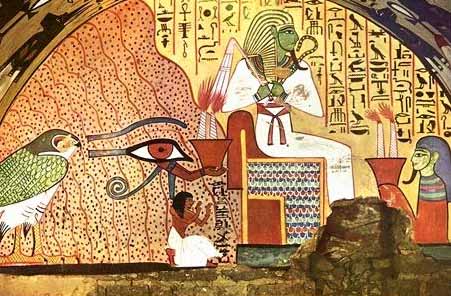
The reference to the "Egyptian mother" is a reference to the myth of Isis and Osiris. Osiris, Isis' twin brother, impregnantes her in the womb of their mother, Nut. This is not the last mention or reference to Egypt or Egyptians. In just a few pages, Starbucks will be described as having the strength of a "revivified Egyptian"; later, Ahab will be described as having an "Egyptian chest", and a whale head will be described in a chapter called "The Sphinx".

Bruce Franklin, in The Wake of the Gods, argued that the "central myth" around which Moby-Dick was constructed was the myth of Osiris, a myth that was chosen in part for it's "unfathomable antiquity", prior to the Hebrew scriptures and to all the known scriptures of the Mediteranean world. For Franklin, Egypt is the "birthplace of the Gods" and Melville's use of Egyptian themes and images is intended to root the book in the most primordial of all worlds.

Here is Franklin's summary of the core of Osiris myth that Melville used, involving Osiris' battles with Typhon (as opposed to the Isis story or some other myths involving Osiris) which he notes is drawn from several somewhat divergent strands in Plutarch and in Thomas Maurice's Indian Antiquities:

Osiris is a priest-king-god who sails the world in a ship that later becomes the consellation Argo. He hunts Typhon, who is usually represented by some kind of aquatic monster and who symbolizes the ocean and all in nature that is malignant to man. Once a year, Typhon dismembers Osiris. When this happens -- the date is variously given as the autumnal equinox, the winter solstice, and the period in between -- Osiris disappears for a certain length of time, which is also variously given. During this absence from earth, he rules the infernal regions and a ship sails the world bearing his coffin. During this time, also, his phallus is missing and the land lies infertile. In a vernal phallic ritual, Osiris is healed and the fertility of the land is restored. His dismemberment in the fall or winter symbolizes the seasonal disaster in nature. The seasonal ressurection of the sun causes, symbolizes, or is symbolized by his resurrection.


I will not try to provide you with all the many details, analyses or wonderful turns of phrases offered by Franklin; there are some deep and convincing discussions (the comparison of Ahab's dismemberment and recession to Osiris), some "Oh My God!" revelations (Osiris' symbols were the hawk, the coffin and the phallus!), and highly questionable assumptions (as discussed in an earlier post, that humorous discussions of myths should be discounted in importance), all melded together with a close reading of Melville's own words. Franklin approaches the book with a fascinating methodology, steeping himself, over an extended time, in the comparative mythology of Melville's own time, giving short shrift to the more modern, and trying to resurrect himself as something of a 19th century comparative mythologist.

For us, armed with Franklin's description of the myth, here at the first mention of Egypt, it is time to start looking for the small bits of Egyptian bird seed sprinkled about the book and seeing where they lead. My own view is that the Osiris myth is "A" very important part of this world Melville has created, but by no means "THE" central mythology. There's more afoot! But I want to inject Osiris into the discussion now, so we can visit the myth again in the coming pages, and see what we find.

Oh, and do note closely, that while Osiris is undergoing the death phase of his cycle of death and resurrection, he rules over the underworld.

Monday, December 5, 2011

Of useful false dichotomies

Critics seem to split into two camps: those who read Moby Dick as part of the Western tragic tradition, a camp that notably includes Charles Olson and Hershal Parker, and those that read Moby Dick as part of a legendary epic tradition, a camp whose strongest voice is Bruce Franklin, the student of the group's founder, Yvor Winters. These camps do love to spar.

The first camp begins with Shakespeare, and when you begin there, really, how far do you ever need to travel? They generally see Melville (and his friend, Hawthorne) facing a fundamental problem: how do you write tragedy, which is dependent on having grand characters whose fall carries weight and so fitting for societies filled with nobles and royals, in a Jacksonian leveling democracy? I will confess, I find it baffling how this could be a problem. One need only look to General Jackson for a grander-than-life figure with tragic implications in a Jacksonian democracy: there is an Ahabian cast to the fellow. Moreover, Melville lived in a world where romantics agag at the sublimity of the American frontier coexisted with practical settlers continually afear of the endless dangers there. And, as if we need yet more tragedy for a young democracy to handle, he wrote during the decade when slavery was showing its local obstinancy even as much of the rest of the world had retreated from it a generation or two before, and the civil war loomed on the horizon, increasingly undeniable and as grand a tragedy as could be imagined. It doesn't seem hard to find tragic subjects in that place and time, though, still, it seems not just a noble but a very useful and practical goal to fashion a true American tragedy in such a world, a tragedy which might even provide a bit of a survival manual for such a world. This camp of critics has a particular fascination with Ahab and his drama; for them the Whale seems vastly less of a character than Ahab, a mere foil rather than a subject of its own. Ahab, however, is the incarnation of every Shakespearian tragic hero, from Lear and Cesar and Anthony right on, with several of the historical figures thrown in.

The second camp seeks all over the edges of the watery parts of the globe for answers to where the inspiration came for the epic legend that is Moby Dick, and almost seems to merge in the Whale all the shadowy looming figures of the world's legends. For this camp, the Whale is as much at the center of the book as Ahab; the book has two demi-gods entwined in a divine and fatal minuette. They find answers from the Ancients of India, Israel and Egypt, from Milton, from everywhere where man contemplates unknowables and unapproachables, horrible, divine and both. For this camp, those long chapters on Whales and Whaling loom large and the philosophical asides become central.

Let us consider the tragedians our strings and the mythologists our brass, and see what music we can make. I will be musing more on both camps.