Tuesday, February 7, 2012

The Song of the Typhoon: First Verse


When first we meet Ishmael ashore, and we learn of his plans to escape the damp, drizzly November of his soul by going to sea, Melville graces us with some twenty beautifully wrought witty and easily read chapters. Then, we begin drifting asea, and things get strange, turgid, and considerably slower. For almost a hundred chapters, we timelessly drift, learning of whales and whaling as one after another whale's spout goes red as the whale turns. Other boats are met and other characters emerge as Melville encourages our speculation, prepares us for what is to come, and waxes philosophical. There is a sea-rhythm to it all. We sail towards South America, cross the Atlantic to the horn of Africa, and cruise through the Indian ocean. Passing the west of Australia, we cross into Asian waters at the Sunda Straight, sail the South China Sea, and enter the Pacific just south of Taiwan. We have passed every continent, save only Europe, though on these waters we have met one set of Europeans after another.

But, after entering the Pacific and heading for the Japanese hunting grounds, the pace quickens and the intensity builds. In "The Candles", St. Elmo's Fire lights up the boat's masts as we turn south toward the Equator and a typhoon hits. With all the drama and charged meanings of this chapter, as signs and signals literally light up around us, we enter a very new, different and exciting part of this book.

"The Candles" is packed. The pace now is that of a page-turner, the language pushes us forward, and the form is dramatic. Let us unpack this chapter a bit.

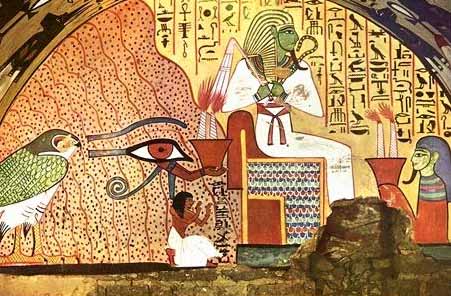
"Warmest climes but nurse the cruellest fangs" begins the chapter; "[s]o, too, it is, that in these resplendent Japanese seas the mariner encounters the direst of all storms, the Typhoon." The Pequod enters a Typhoon, its masts are shorn of sail, and thunder and lightening blaze about, showing the rag-tattered masts in profile. This is a stormy setting, remiscent of the storm that hit in the first act of our dramatic chapters, in "Forecastle - Midnight", when Pip and his tambourine were introduced to us. The storm, the "Typhoon" with a capital "T", has been read as repleat with meaning, as a storm demonstrating divine intelligence, for in this chapter, besides bearing that capital "T" name, it will respond to the actions of the crew. Here is the chapter where Franklin's reading of Ahab as the personification of the Osiris/Typhoon myth of ancient Egypt rings most true.

Once the stage's background is set and our storm is upon us, the characters enter: Starbuck on the Quarterdeck, attempting to contain the damage, Flask and Stubb before him, vainly securing the boats. Vainly because, our storm-with-a-will sends a sea to crash Ahab's whale-boat, in the very place where Ahab stands. Stubb laughs, tells Starbuck the sea will have its way, and sings a song for us, with a refrain "Such a funny, sporty, gamy jesty, joky, hoky-poky lad, is the Ocean, oh!" Stubb is steeling his will with song; the fact is, he is frightened to hell by the storm's power.

Starbuck, however, reads the storm, and understands its will. To Stubb's song, we get a grand line from Starbuck: "let the Typhoon sign, and strike the harp here in our rigging". The harp has sung in just one other place in the book: right after Ahab blesses his harpoon in pagan blood, he attaches the harpoon to a rope and makes it hum "like a harp-spring" in "The Forge". The exchange between Stubb and Starbuck here focuses on music and bravery, but note throughout the references to other chapters: Stubb talks of "singing the doxology", and the doxology is likewise referenced in "Fast-and-Loose Fish" as the song sung by the victor making fast a fish another had harpooned but left loose. As a pivotal chapter, you will find many strands of the story, many references, pulled together here. Expect this to continue in these fast-paced final chapters. Also note the changes to the sense of humor, which becomes much more gallows humor in its bent; the slapstick abates as we hit hight drama, and the humor takes on deadly irony.

As Starbuck reveals to us, the rapt audience, that the storm will turn fair if they turn for home, but will continue to hammer them if they instead head for the Line and Moby-Dick; at this moment, Ahab appears as a disembodied and unintelligible voice in the dark; finally, when asked who is there, he answers, mid-Typhoon, "Old Thunder!" Ahab identifies with the storm and embraces the very typhoon that is assualting them.

What have we so far to our drama: a storm with a will, a crew whose leader reads the signs in the storm, but whose other members are simply terrorized, and a captain who embraces the storm and its terror. Reading this with the Osiris myth, we are approaching the time of Osiris' dismembering by Typhoon, before Osiris wanders the earth in his coffin for six months, in a natural, eternal, and recurring progression.

This is the first verse of the Song of the Typhoon; in our second verse, the next posting, the stage, with Ahab on it, will be reset slightly as we get a short scientific discussion of boats, lightning, and lightning rods, and following this, the corposcants, or St. Elmo's Fire, will appear, and Ahab will take center stage from Stubb and Starbuck.

Monday, February 6, 2012

True Religion

"The Whale Watch", chapter 117, is, to my way of thinking, the single most devoutly religious chapter in this book filled with every religion born of Babel. After a day in which four whales were killed, far apart around the boat, Ahab and Fedallah (and their crew, but they are silent) float all night by a dead whale that they could not get back to the boat during the day. As the lamp casts its glow across midnight seas, Fedallah provides Ahab with a prophesy, a prophesy that we and Fedallah know to be grim, but that cheers Ahab:
"But I said, old man, that ere thou couldst die on this voyage, two hearses must verily be seen by thee on the sea; the first not made by mortal hands; and the visible wood of the last one must be grown in America."

"Aye, aye! a strange sight that, Parsee: - a hearse and its plumes floating over the ocean with the waves for the pall-bearers. Ha! Such a sight we shall not soon see."

"Believe it or not, thou canst not die till it be seen, old man."

"And what was that saying about thyself?"

"Though it come to the last, I shall still go before thee thy pilot."

"And when thou art so gone before - if that ever befall - then ere I can follow, thou must still appear to me, to pilot me still? - Was it not so? Well, then, did I believe all ye say, oh my pilot! I have here two pledges that I shall yet slay Moby Dick and survive it."

"Take another pledge, old man, said the Parsee, as his eyes lighted up like fire-flies in the gloom, - Hemp only can kill thee."

"The gallows, ye mean. - I am immortal then, on land and on sea," cried Ahab, with a laugh of derision; - "Immortal on land and on sea!"

Melville casts no doubt or ridicule on the prophesy; he does not even color it. Where other prophesies are made, as with Elijah, they are delivered with more than a touch of madness. Where other outrageous, difficult to verify statements are made, whether regarding the swallowing of Jonah or the chance of meeting up with the same whale twice, we get some discourse attempting to explain, justify or even just gild the extraordinary statement. This is bare, dramatic, and, most of all, true to what will occur.

Only here, in the words of this Zoroastrian, in the dark of night, lit only by a bit of oil and Fedallah's eyes, do we find true and unquestioned prophesy. Is this Melville's Pauline moment?

Saturday, February 4, 2012

Homeric Visions


I love hearing when someone can identify a favorite moment in Moby-Dick. My own is in "The Castaway" chapter, when Pip goes mad. Our favorite moments say much about each of us, and what attracts us to this unweildy, diverse, frolicking work. Favorites are personal moments, moments that seemingly have little to do with any objective assessment of the work.

Nathaniel Philbrick, in Why Read Moby-Dick, dwells on his favorite moment, in the first paragraph of Chapter 85, "The Fountain":
That for six thousand years—and no one knows how many millions of ages before—the great whales should have been spouting all over the sea, and sprinkling and mistifying the gardens of the deep, as with so many sprinkling or mistifying pots; and that for some centuries back, thousands of hunters should have been close by the fountain of the whale, watching these sprinklings and spoutings—that all this should be, and yet, that down to this blessed minute (fifteen and a quarter minutes past one o'clock P.M. of this sixteenth day of December, A.D. 1851), it should still remain a problem, whether these spoutings are, after all, really water, or nothing but vapour—this is surely a noteworthy thing.*

Melville writes down here the very moment of his writing, fifteen and a quarter minutes past one o'clock P.M. of this sixteenth day of December, A.D. 1851 (though the date of first writing was actually one year prior, and the year was changed prior to publication in 1851). Philbrick describes his reason for "favoriting" this passage of Moby-Dick: "Melville did something outrageous. He pulled back the fictive curtain and inserted a seemingly irrelevant glimpse of himself in the act of composition." In Philbrick's assessment, the "seemingly" in "seemingly irrelevant" is everything. This is not an irrelevant glimpse, but central to the work and one of the many engaging facets of what, in our discussions, we have called Melville's epistemology.

First, let us look at this passage, then, let us look back at another passage that pressages this one. You will find more.

Here, the narrator is pondering on the long length of our ignorance concerning the whale's spout. Look at the opening phrase: "That for six thousand years -- and no one knows how many millions of years before", and think on this contrast. The six thousand reference is Biblical, the approximate age of the world as calculated by Biblical sub-subs, and so reference's God's creation of the world; the millions of years could be geological, referencing then-common scientific thoughts about the possible world's age, or it could be a reference to the unformed world of welter and waste before Genesis, or to the Hindu cycles of prior worlds, or to something else before the dawn of human time. The phrase, like just about everything here, is half-satirical, but, still, our setting tells us that we are dealing with the ultimate of human time or divine time, and that, throughout this ultimate stretch, with regard to this topic, we have but ignorance. But we are as ignorant of what this time may be as we are ignorant of what the whale's spout truly is.

I have observed already that once at sea time becomes almost irrelevant; we cease to mark days or even weeks, references come only to where we have gotten, not how long we spend there or how long it has taken to get there. In the vast hundred chapter stretch of drifting timelessness, there are just two or three places where time suddenly and meaningfully errupts into the narrative, and, here, it erupts with overwhelming precision, down to a fraction of a minute. Yet, the time that matters is not of the story itself, but outside the story, and that is where Melville is pulling us. He wants to remove us at this point from the narrative, bring us into his library, and talk to us about what we are doing. Later in the chapter, he makes the conversation even plainer:
But why pester one with all this reasoning on the subject? Speak out! You have seen him spout; then declare what the spout is; can you not tell water from air? My dear sir, in this world it is not so easy to settle these plain things. I have ever found your plain things the knottiest of all. And as for this whale spout, you might almost stand in it, and yet be undecided as to what it is precisely.

Melville is pulling out out of the book to talk about the mistical spout of the whale, which is the whale's very life breath yet a thing that defies our attempts to understand it, whether through observation or divinitation. He pulls us out of the book to talk about the difficulty of knowing and the ultimate mystery of knowing the very things he is telling us. Melville's epistemology applies not just to the world of whales, but to the world of books and stories as well.

I am reminded here of the great Hindu bards, whose own stories interweave with the stories they tell, replete with protestations about their own ignorance and inadequacey to tell the story or explain its meaning. In these passages, the challenge of writing and telling and reading the story, the challenge of the hunt for the whale, and the challenge of perceiving, knowing or understanding anything all come together, no so much in an allegorical way as in a direct comparision of the underlying struggles we face in each endeavor. Melville is stepping out of the novel so as to avoid it becoming a mere allegory.

Now let us go back to the chapter "The Affadavit", where our narrator is discussing the unlikely occurance, in the near-infinite breadth of the world, that a sailor should not only meet but actually harpoon the same whale more than once. This is a chapter, or at least an opening of a chapter, about chance and determinism, about the extent to which the world itself avoids randomness. The chapter begins with a commentary on the proper way to read the book:
So far as what there may be of a narrative in this book; and, indeed, as indirectly touching one or two very interesting and curious particulars in the habits of sperm whales, the foregoing chapter, in its earlier part, is as important a one as will be found in this volume; but the leading matter of it requires to be still further and more familiarly enlarged upon, in order to be adequately understood, and moreover to take away any incredulity which a profound ignorance of the entire subject may induce in some minds, as to the natural verity of the main points of this affair.
The prior chapter was "The Chart",** where Ahab set to charting his course to seek to intersect the White Whale. In "The Affadavit" and "The Chart", again stepping into his book, Melville provides us with a series of underlying stories, all assertedly factual, that, regardless of the incredulousness of the proposition, show us that sailors do come upon and harpoon the same whale more than once. Like many a chapter, however, there is a mid-narrative pivot, where the discussion moves from the lack of randomness of these meetings to the extraordinary power of the whale upon a meeting. Throughout, however, the voice of the narrator is one that is concurrent with its reading, that steps out of the stream of the book and back into the narrative layer. It is in this tension, between the story, the telling of the story, and the interpretation or meaning of the telling of the story, that we lose Ishmael's voice and gain a narrator's voice -- and perhaps, in places, a narrator named Herman.

Philbrick rightfully revels in the outrageousness of Melville's approach. I look at it, and wonder, given Melville's own concern with the difficulties of knowing, perceiving, understanding, is this approach almost self-evident? Doesn't Melville's story and his approach to the story almost demand such that the Bard present himself to us to explain? Reading Moby-Dick, I come to more fully appreciate the blindness of Homer.

* An utter aside but an irresistable one: isn't Melville's use of the word "mistifying" wonderful? Those spouts, which so mystically adorn the horizon in "The Spirit-Spout", are but spreading mist. Their etymological roots differ, mist being a fractured part of compound words used in the Old English and Icelandic - misthleoðu "misty cliffs," wælmist "mist of death" - and mystic coming to English from Old French but going back to the Greek "mystikos"). So these words floated about for some thousand years before Melville found and married them.

**The Chart contains, in a footnote, another of the reference during the sea chapters to time. In commenting on the attempts to chart out migratory patterns of whales described in the body, the footnote cites to a circular, dated April 16th, 1851, released "since the above was written", another unveiling of the writer's work. The image above, by the way, is from Dalhousie University, and shows a current rendition of various marine animals' Pacific migratory patterns, including whales.

Thursday, February 2, 2012

Of Ishmael and Cetacean Foreskin


In earlier posts, I looked at Melville's use of the Egyptian myth of Osiris, in which Osiris is, like Ahab, dismembered by Typhon each year and then reborn, and the Hindu snake sacrifice myth in the "Ramadan" chapter, where the devout sage is ridiculed and mocked while carrying out a vow of silence. We have also looked at the Old Testament myths of Job and Jonah, preached through Christian authority. But we would be remiss if we did not delve more into more purely classical and Hebraic mythology.

In an article in Poetics Today (1998), Elisa New rereads Moby-Dick as critically focused on the conflict between Ishmael, whom she sees as an Hebraic scribe and the hero of the story, and Ahab, whom she sees as the flawed and anti-heroic voice of Hellenism and, in particular, of Pauline Platonism, a sort of angry Emerson in a toga. Ishmael, forever classifying, forever spewing legalisms, becames a wise Rabbinical sub-sub authoring a story that is a new Deuteronomy and a new Ecclesiatics, upholding the power and logic of the Word. Ahab, forever soliquizing, is the embodiment of a Christian/Hellenic spirit which wishes to embrace, conquer, and unify the very essence of the world. Ahab is St. Paul to Ishmael's Moses. Ishmael lives; Ahab dies.

New's reading grounds itself on a number of chapters she sees as the ultimate expression of "Ishmaelic scribalism", "Cetology" and "Fast and Loose Fish" among them, contrasted with a handful of chapters she finds deeply imbued with Hellenism: most prominently "The Cassock". In "The Cassock", a mincer cuts thin sheets of the blubber to feed into the flames of the try-works while encased in protective clothing crafted from the whale's penis skin, and New quotes the chapter:
"Bible Leaves! Bible Leaves!" This is the invariable cry from the mates to the mincer. It enjoins him to be careful, and cut his work into as thin slices as possible, inasmuch as by doing so the business of boiling out the oil is much accelerated, and its quantity considerably increased, perhaps increasing its quality.

Here is what she makes of it:
Melville's caustic allusion to "Bible Leaves!" makes it ambly clear that his mincer is a satirized minister. Traducing the materiality and history of the world's body in pursuit of its perfect spirit, this cassocked divine is one of Melville's many figures of a sacrificial and deadly Christian Hellenism, whose essentialist legacy Melville opposes with all the textual resources he can marshal. In another context, the analogy between the rendering of whale fat and the extraction of essence from Scripture might seem merely playful....This tableau of the tireless priest feeding leave to the fire and working, moreover, in an apron fashioned from the whale's own stupendous penis is calculated to elicit laughter.

There is indeed something here in her quote and analysis; the whale oil as essence, the giver of light; the humor of a cassocked mincer dressed in a penis feeding the Bible to hellfire; the send up of preachers and their hellfire rants; the intermixture of the demonic and the sacred.

But, somehow, New, as earnestly scholastic as any sub-sub, boils down the whole book into a single conflict between Hebrews and Christians/Greeks; she peels away the chapters to reveal in them her own most favored and most despised mythologies, and in so doing, gives the role of sacred law-giver and true superhero to Ishmael. She even identifies the Hebrews as the winners; the book becomes an anti-Platonic diatribe.

While it is good to see Ishmael raised up to such heights rather than in his usual role as the mere Bard of the two great characters of Ahab and Moby-Dick, a sort of Cetacean side-kick, I can not help but find this approach, well, sort of essentialist and Hellenistic of her. Come now. We can't read out the Hindus and Egyptians. More is afoot.

Tuesday, January 31, 2012

The Voice of the Whale

Throughout Moby-Dick, we look at Whales from many perspectives, considering their classification, the function of a whale's body, the whale's phrenology, the uses of various body parts, from blubber to skelaton, hide, muscle and brain, the history of whale hunting, the taste, and many more, too numerous to usefully catalog. We try to understand what The Whale is to Ahab, and what it is to Ishmael. Melville teases us throughout, however, with our failures of knowledge and the limitations of each perspective.

In the chapter, "The Sphynx", Melville very nicely has Ahab summarize the frustrations of our limitations, and highlights the one perspective we will not get: the whale's own:
"Speak, thou vast and venerable head," muttered Ahab, "which, though ungarnished with a beard, yet here and there lookest hoary with mosses; speak, mighty head, and tell us the secret thing that is in thee. Of all divers, thou hast dived the deepest. That head upon which the upper sun now gleams, has moved amid this world's foundations. Where unrecorded names and navies rust, and untold hopes and anchors rot; where in her murderous hold this frigate earth is ballasted with bones of millions of the drowned; there, in that awful water-land, there was thy most familiar home. Thou hast been where bell or diver never went; hast slept by many a sailor's side, where sleepless mothers would give their lives to lay them down. Thou saw'st the locked lovers when leaping from their flaming ship; heart to heart they sank beneath the exulting wave; true to each other, when heaven seemed false to them. Thou saw'st the murdered mate when tossed by pirates from the midnight deck; for hours he fell into the deeper midnight of the insatiate maw; and his murderers still sailed on unharmed - while swift lightnings shivered the neighboring ship that would have borne a righteous husband to outstretched, longing arms. O head! thou hast seen enough to split the planets and make an infidel of Abraham, and not one syllable is thine!"

Is the whale a divinity? Is the whale endowed with godlike power, the power of omnipresence, the power of life and death? Or is the whale simply the faceless, voiceless and ever-distant observer of history? Mid-way through the book, in a chapter that serves as a bit of a finale to the gory chapters of the cutting in and dissection of the whale (we will revisit the dissected whale and its parts later, as they are fed to the try-pots and the oil is rendered), Melville wishes only to heighten our questions, and brings Ahab on the stage to ensure we are paying attention.

Monday, January 30, 2012

Filling Bottomless Bellies


When we began Moby-Dick, there was foreshadowing aplenty, with the early chapters working very hard to build up the tension for the coming half-knowns. But once we are at sea, beginning with Ahab's speech to the crew on their true mission and the sudden emergence of Fedallah and his crew from the hold as the first boats are lowered, that which has been prophesied and foreshadowed begins to play out. As we emerge from those wild chapters just after they find the open ocean, the first dramatic chapters, the first tempest as Pip appears, the early Cetology chapters, the epic tale itself begins playing out. Now, our references as often look backward, to the first inklings and the small bread crumbs dropped for us, as they do forewards, building to the still grander and more untamed heights of the finale.

The cook's sermon to the sharks is one such moment, where the foreshadowing of the early chapters is reflected, and shown in a new and different light, in the heart of the book. This chapter, to me, is but a revisiting of Father Mapple's sermon, wherein he retold, in somewhat mangled form, the story of Jonah, heightening the conflict among men, increasingly the role of money, and focusing the Biblical messsage of obedience on the particlar role of speaking God's truth to evil. Now, however, instead of the noble father who rises to the pulpit to preach to a congregation of rough but pious sailors, we have the cook speaking to a congregation of blood-maddened sharks:
"Your woraciousness, fellow-critters, I don't blame ye so much for; dat is natur, and can't be helped; but to gobern dat wicked natur, dat is de pint. You is sharks, sartin; but if you gobern de shark in you, why den you be angel; for all angel is not'ing more dan de shark well goberned. Now, look here, bred'ren, just try wonst to be cibil, a helping yourselbs from dat whale. Don't be tearin' de blubber out your neighbour's mout, I say. Is not one shark dood right as toder to dat whale? And, by Gor, none on you has de right to dat whale; dat whale belong to some one else. I know some o' you has berry brig mout, brigger dan oders; but den de brig mouts sometimes has de small bellies; so dat de brigness ob de mout is not to swallar wid, but to bite off de blubber for de small fry ob sharks, dat can't get into de scrouge to help demselves."

It is a simple speech, humbly told. Watch the accent: is that "sartin" a play on "satan" as well as "certain"? Does "gobern" suggest not just governing but "burning"? And, what can you do with "Gor" for "God"? Melville is having a grand time here, but I often sense that he is most serious when he is most comic. The sermon on land, with its pomp and its practiced drama, gives way to the truer heartfelt sermon at sea, a sermon which speaks to a congregation in the midst of its grand and bloody gluttony. The sermon quickly takes a quick philosophic turn:

"Well done, old Fleece!" cried Stubb, "that's Christianity; go on."

"No use goin' on; de dam willains will keep a scrougin' and slappin' each oder, Massa Stubb; dey don't hear one word; no use a- preachin' to such dam g'uttons as you call 'em, till dare bellies is full, and dare bellies is bottomless; and when dey do get em full, dey wont hear you den; for den dey sink in de sea, go fast to sleep on de coral, and can't hear not'ing at all, no more, for eber and eber."

We are all sharks, with nature governing even as we spin our sermons. No use preaching to us until our bottomless bellies are full. Father Mapple's Jonah has nothing on Cook's High Feast of the Sharks, and, indeed, Cook to me is the compelling counterpoint to Mapple's opening argument. Cook's closing lines prophesy anew for us, foreshadowing that which is still to come, punctuated with yet more guffaws for the groundlings, when Cook says of Stubb "'I'm bressed if he ain't more of shark dan Massa Shark hisself,' muttered the old man, limping away; with which sage ejaculation he went to his hammock."

Sunday, January 22, 2012

Whiteness?

We have talked of many different categories of chapters: the mystical chapters like "The Mast-Head", the comic chapters like "The Cabin Table", the encylopedic chapters like "Cetology", the dramatic chapters like "Enter Ahab; To Him, Stubb". There are two things about "The Whiteness of the Whale" that stand out for me.

First, this chapter fits into all of those categories but the dramatic; it is simultaneously mystical, comical, and encyclopedic. This sudden unity of strands in a single chapter is critical to the broader architecture of the book. Yes, there are elements that predominate: the mystical, here, it strikes me, dominates the tone of the language, even as comic and encyclopedic elements are worked in, and even as bit of dramatic language, Shakespearian in character if not dramatic in presentation, also bubbles to the top.

Secondly, the chapter comes to us right after we are told, in the prior chapter, "Moby-Dick", that the Whale is not actually or entirely white.
For, it was not so much his uncommon bulk that so much distinguished him from other Sperm Whales, but, as was elsewhere thrown out - a peculiar snow-white wrinkled forehead, and a high, pyramidical white hump. These were his prominent features; the tokens whereby, even in the limitless, uncharted seas, he revealed his identity, at a long distance, to those who knew him.

The rest of his body was so streaked, and spotted, and marbled with the same shrouded hue, that, in the end, he had gained his distinctive appellation of the White Whale; a name, indeed, literally justified by his vivid aspect, when seen gliding at high noon through a dark blue sea, leaving a milky-way wake of creamy foam, all spangled with golden gleamings.
Whiteness is an apperance; the reality is mottled, streaked, marbled, only partly and not fully white.

In fitting with the only partial whiteness of the Whale, this chapter itself, describing what the Whale is to Ishmael, seems intensely vaccilating even while increasingly emotionally intense. The chapter begins with Ishmael's focus on how "It was the whiteness of the whale that above all things appalled me", but then immediately launches into many positive conceptions of white, from marbles and pearls to royal connotations to mythical ones. The appallingness of white is but an introduction; Melville now graces us with the beauty and splendor of Whiteness.

He then transitions into "elusive" qualities and indeterminicies, and, in a staggeringly original moment, graces us with a massive footnote on the Albatross, a footnote which at once engages in a direct literary conversation on Coleridge and his symbols, an encylopedic dicussion of birds, and a mythical exposition on angels and Abraham, all of which is resolved in the mechanics of a capture and release of the bird. It is a grand moment of foreshadowing, yet one that works neatly into the story.

It is only after we work through the long and positive discourse on whiteness that the dread-inducing aspects of it arise, and the fundamental ambiguity of the color is explored. Look carefully at the chapter: you will find in it references and anticipations of many prior and later chapters, discussions that will resound as we move through mist or as we meet a Goney of another type.

A beautiful, simple chapter, yet one that pulls strands from the whole work together, weaving them into a more complex and multi-fibered yarn.

Tuesday, January 17, 2012

The Stage, The Storm; Enter Pip


I have a few thoughts today on several of the most critical and dramatic chapteers of Moby-Dick: the dramatic chapters beginning with "The Quarter-Deck" and ending with Pip's speech as the tempest breaks in "Midnight - Forecastle". There is an obvious and radical technique interjected here, where Melville begins each chapter with stage directions and very explicitly frames them as a dramatic production. This is a work-within-a-work, a framed story, in the tradition of the Thousand-and-one-Nights, the Panchatantra, The Canterbury Tales and Shakespeare's Hamlet and Midsummer Night's Dream.

Now, there is little I can say here that you cannot read. It may be helpful to know that there are four such dramatic sequences in Moby-Dick; the first one, a more subtle one that launches into the play format mid-way through the chapter, is "Enter Ahab; to him Stubb". The next is a short, one chapter interlude, "Ahab and the Carpenter", surrounded by other dialogue heavy but not fully dramatic chapters. The final one is the long sequence that begins during "The Candle" and ends with "The Cabin" immediately prior to the final chase scenes. These dramatic chapters are of a piece, and highlights a play among a subset of the human characters in the book.

Also, look carefully at the key curtain scenes. Perhaps the only character whose entrance is built up nearly to the same degree as Ahab and Moby-Dick is Pip; he is first introduced, silently, in Knights and Squires, and he receives the curtain speech at the close of this critical act.

One of the elements of the play-within-a-novel technique that is so effective is that Melville can foreshadow far more effectively and with more subtlety than the average playwright; the novelist elements beforehand introduce and color each of the characters when they show on the stage, giving them the depth of character that might not appear until the third act at the very point where the curtain rises.

The contrast between these chapters and what comes before also heightens the drama: we move from our yarn before the fireplace with Ishmael to find the fireplace pulled back and a sudden congregation of the players that were heretofore just words in Ishmael's mouth in front of and above us on a stage, suddenly larger, better lit, and more colorful than we might have imagined them, and, in each case, no longer mute. Our prior intermediary, Ishmael, drops away entirely and we commune with them directly; he may be sitting in the back of the audience with us, but he takes on the former muteness of many of the characters. We no longer suspend disbelief: we are to believe.

Now, let's take a quick look at the curtain speech for this act, delivered as a storm breaks (the image above is Turner's "Tempest") after a rowdy, drunken, multi-cultural dance act, perhaps the single most pagan moment of the whole pagan book:

Jollies? Lord help such jollies! Crish, crash! there goes the jib-stay! Blang-whang! God! Duck lower, Pip, here comes the royal yard! It's worse than being in the whirled woods, the last day of the year; Who'd go climbing after chestnuts now? But there they go, all cursing, and here I don't. Fine prospects to 'em; they're on the road to heaven. Hold on hard! Jimmini, what a squall! But those chaps there are worse yet - they are your white squalls, they. White squalls? white whale, shirr! shirr! Here have I heard all their chat just now, and the white whale - shirr! shirr! - but spoken of once! and only this evening - it makes me jingle all over like my tambourine - that anaconda of an old man swore 'em in to hunt him! Oh, thou big white God aloft there somewhere in yon darkness, have mercy on this small black boy down here; preserve him from all men that have no bowels to feel fear!


Is Pip's speech the speech of the fool or the tragic hero? Or the speech of a fool delivered by a tragic hero? Watch Pip.

Monday, January 16, 2012

Heed Well, ye Pantheists!

Melville, realizing that he made extraordinary demands on the reader in that Cetology chapter, generously rewards the reader afterwards: after a short interlude contemplating Ahab's multi-tiered crown in the "Specksnyder", we get some good old-fashioned slapstick in "The Cabin-Table" and a blissful reverie in "The Mast Head".

The Cabin-Table continues some of the formal innovations that began being introduced as we left shore. Now, Ishmael's voice is wavering, and a third-person narrator seems to be trying to edge his way into the book. Suddenly, we have scenes told by Ishmael where he is not present. Melville begins the transition carefully, almost imperceptibly, but it will become more pronounced quickly.

The Cabin-Table, like many chapters, easily splits in two, with the first half emphasizing Ahab's royal table, which is carried out each day with great ceremony and deference, much to the dismay of the lesser nobles who serve Ahab. Watch carefully the language here, and remember throughout that at least two of the harpooners have already been identified as royals in their own right. Part two of the chapter features the more lively and democratic table of the harpooners, one which none-the-less plays havoc with the servants. Here is where the real slapstick occurs, as the poor Dough-Boy finds himself at the mercy of hungry savages who gleefully salivate over the prospects of having the Dough-Boy himself on their plate. The bifurcated chapters beg for comparison (indeed, Melville introduces the second part with the words "in strange contrast"). When comparing, expect a richness of ironies almost folding in on themselves. The democrats are baronial while the nobles suffer privation.

This is a rudely comic chapter for Ahab to play a role in, though Ahab does not speak and the true comedy is contrasted with his own mute and formal table. Watch the closing description of Ahab in this chapter, as telling and interesting a description as you'll get (and you will get many!):

Though nominally included in the census of Christendom, he was still an alien to it. He lived in the world, as the last of the Grisly Bears lived in settled Missouri. And as when Spring and Summer had departed, that wild Logan of the woods, burying himself in the hollow of a tree, lived out the winter there, sucking his own paws; so, in his inclement, howling old age, Ahab's soul, shut up in the caved trunk of his body, there fed upon the sullen paws of its gloom!


We do not stay long in the sullen paws of a gloomy soul, however, we rise quickly in the next chapter to the height over which the great ocean can be surveyed. Here, let us start from the last and weighty language of this chapter (note how often the last language is the most important of the drama), where Ishmael addresses himself to the gently swaying mystics atop the mast-heads:

There is no life in thee, now, except that rocking life imparted by a gently rolling ship; by her, borrowed from the sea; by the sea, from the inscrutable tides of God. But while this sleep, this dream is on ye, move your foot or hand an inch; slip your hold at all; and your identity comes back in horror. Over Descartian vortices you hover. And perhaps, at mid-day, in the fairest weather, with one half-throttled shriek you drop through that transparent air into the summer sea, no more to rise for ever. Heed it well, ye Pantheists!


That is wonderful, lulling and rhythmic language, but there references are themselves worthy of ponder. Let yourself be mesmerized as you read, but go back and scratch your head a bit when you're done.

The phrasing is fraught with religion, history and mythology. Read in it claims of ancient Egyptian primacy, and the genuflections to monastics and early Christians and Rhodes; the references to heros of many lands (Washington, Napolean, Nelson); progress from there to historians and fablists; and finally, arive at the philosophers and poets. Like the man on the mast head, blissfully bobbing with his mind adrift, we survey a broad expanse here before reaching the end, where we are reminded that there are dangers to our reverie. Reveries interfere with commerce; indeed, they even threaten survival.

Yet, it's been a pleasant read, and Melville's set up a great transition from one daring and difficult chapter in Cetology to a series of truly unexpected chapters to follow from here.

Sunday, January 15, 2012

Of Cetology and Chaos


Much has been written about Cetology.

For example, there are some for whom Cetology is what it purports to be: a Cetological classification of whales based on a review of the literature and personal observation. See, for example, this discussion in Wikipedia, which neatly summarizes the Cetological classification among different books (e.g., Folio, Quarto, Duodecimal), and contrasts it to modern Cetology, which has over ninety categories of whales, far more than known by Ishmael.

Others, however, perceive the deeper import of Cetology. In CallmeIshmael, for example, a particularly melodic blog, we can see a reading of Cetology which focuses on the chapter's exceedingly random classifications of whales as a critique of racism and the random classification of people.

Yet others classify the chapter based on its relative length, and it is, of course, among the longest of chapters in Moby-Dick. These scholars often note Melville's painstaking efforts to do everything possible to accentuate the apparent length of the chapter, just as many an "usher"(*) knows how to make the most of the last five minutes of every hour.

Still others emphasize the role played by the knowledge imparted in this chapter and its utility in the narrative sections of the book, where the discussion frequently uses terms with some technical precision in the whaling industry. Confer, for example, Howard P. Vincent, The Trying-Out of Moby-Dick, p. 123.

Finally, there are those who view all cetological discussions, and all discussions on whaling in general, as "in essence metaphorical", comparing whales and in particular the whale to the condition of man. A fine example of this is found in J.A. Ward, once of Tulane University, in his "The Function of the Cetological Chapters in Moby-Dick", which first revealed this reading to a here-to-fore unsuspecting public in the May, 1956 issued of "American Literature".

I, however, would propose that we reject each of these approaches to Cetology, and instead focus simply on one small statement at the beginning of the chapter, where Ishmael tells us what he is doing:
It is some systematized exhibition of the whale in his broad genera, that I would now fain put before you. Yet is it no easy task. The classification of the constituents of a chaos, nothing less is here essayed.

Now, usually, I too would not look for answers to great questions in so plain a statement, but, in this case, I would ask that you just humor me. Ishmael describes the whales as "chaos"; could he perhaps mean that they are, indeed, chaos? Chaos is often used in two ways: a collection of disorderly things, or, alternatively, the unformed matter at the beginning of the universe.

If the whales are a collection of disorderly things, perhaps what Ishmael is doing is trying to make order of them, that is, trying to find way to make the chaos make sense to him. Perhaps this is why he classifies based on, for example, size and commercial utility. Under this use of chaos, I might suggest that the classification speaks not to us about the whale, but about the classifier.

With respect to the other definition of chaos, the disordered welter and waste at the beginning of the universe (above is a NASA image of the congealing of matter after the big bang), what can we say of it other than that it is even more unknowable than the God or natural force that ordered it? Is not this chaos, of mythological and scientific reknown, the most puzzling thing of all, and thus the task of putting order to it very much a fictional rather than scientific undertaking, one that relates more to the crafting of myths than the examination of things?

Perhaps, what Melville is trying to do here is show Ishmael doing both things, that is, not just classifying but ordering chaos; but that would put Ishmael, or perhaps Melville, at the treadle of the loom, which is too presumptuous to be believed.

This is all, of course, conjecture on my part. Luckily, Ishmael will examine whales from many perspectives, not just this cetological one, and, perhaps, when we explore these creatures, and the White one in particular, from all angles, and in all ways, we shall gain some knowledge, useful or not, of them.

* Note that the word "usher", as used in Melville's etymology, references a then-obsolete and now even more so use of the word to mean an assistant teacher in a lower school; note further that footnoting this provision through a cross-reference to an etymology does for my discourse much what Melville's thirteen pages did for his Cetology.

Thursday, January 12, 2012

The Pipe


The Pipe is a short chapter. Let us quote it in full:

When Stubb had departed, Ahab stood for a while leaning over the bulwarks; and then, as had been usual with him of late, calling a sailor of the watch, he sent him below for his ivory stool, and also his pipe. Lighting the pipe at the binnacle lamp [pictured, left] and planting the stool on the weather side of the deck, he sat and smoked.

In old Norse times, the thrones of the sea-loving Danish kings were fabricated, saith tradition, of the tusks of the Narwhale. How could one look at Ahab then, seated on that tripod of bones, without bethinking him of the royalty it symbolized? For a Khan of the plank, and a king of the sea, and a great lord of Leviathans was Ahab.

Some moments passed, during which the thick vapor came from his mouth in quick and constant puffs, which blew back again into his face. "How now," he soliloquized at last, withdrawing the tube, "this smoking no longer soothes. Oh, my pipe! hard must it go with me if thy charm be gone! Here have I been unconsciously toiling, not pleasuring, - aye, and ignorantly smoking to windward all the while; to windward, and with such nervous whiffs, as if, like the dying whale, my final jets were the strongest and fullest of trouble. What business have I with this pipe? This thing that is meant for sereneness, to send up mild white vapors among mild white hairs, not among torn iron-grey locks like mine. I'll smoke no more - "

He tossed the still lighted pipe into the sea. The fire hissed in the waves; the same instant the ship shot by the bubble the sinking pipe made. With slouched hat, Ahab lurchingly paced the planks.


Note that the first part of this chapter is quite explicit. Ahab is sitting on a whale-ivory stool, and Ishmael is talking about the symbolism of Ahab sitting there. We don't have to guess that there is a symbol at play - Melville says as much.

Now look at the second part of the chapter. Well, something is happening with this pipe. There is whiteness there, in the smoke, in the hair, and oh how we know white means something here; we are approaching a long discourse on whiteness. More than that, there is fire here, and Ahab will be associated with fire over and over in this book. Ahab is renouncing a firey pipe, but one he gets no pleasure from any more. He seems done with the white, the mildness, and the fire. Thers is regret in the air.

Ah, now there are symbols afoot, and here Melville lets us guess! But, beyond symbols, there is a drama, a short, intense drama of a man having just had hard words with his officers looking for a smoke and a break; he is a restive, somewhat troubled man who can find no satisfaction. Ah, Thomas Mann, can you offer him a Maria Mancini?

This chapter is a wonderful microcosmic read of Melville's method. It is slim, it is dramatic, and one can light one's pipe and think on it for no short period of time. After that thought, you may still not be fully satisfied - blame it on the pipe and toss it aside if you must.

A Break

As Queequeg and I are now fairly embarked in this business of whaling; and as this business of whaling has somehow come to be regarded among landsmen as a rather unpoetical and disreputable pursuit; therefore, I am all anxiety to convince ye, ye landsmen, of the injustice hereby done to us hunters of whales.

So begins the chapter, "The Advocate", where Ishmael pauses the action in his story, much as Krishna on the fields of Kurukshetra, to lay before us his argument for treating whaling as both reputable and poetic. The argument is twofold: first, we are asked to pay attention to the honor and glory due to the whalesman, and, secondly but more subtly, that going to sea in search of whales has "aesthetically noble associations".

Up until now, this book has been a traditional narrative, at least on the surface. On a Saturday in December, Ishmael arrives in New Bedford and has his first night with Queequeg; on Monday, they are off to Nantucket, on Tuesday, Ishmael signs up for the Pequod while Ishmael has his Ramadan. Wednesday, Queequeg makes his mark, and a day or two, perhaps a bit more, passes before notice is given that the ship will sail. Sailing happens on a Christmas - they get to the ship just before six in the morning and are off about noon. There is a story and a pace to it.

Once at sea, however, change is afoot. The first thing we have is the six inch tombstone of a chapter titled the "Lee Shore" and the next thing is this multi-page "advocacy." I see Ishamel before the fire, pausing in his telling, pulling the pipe from his mouth, setting it aside, leaning it forward, and with great urgency telling us listeners to forget all that, we're about to get down the real thing, we're going to Sea! But, first, he has something to get off his chest. This chapter and those like it are addressed directly to the reader, and can forcefully pull us right into the discussion. We are asked to have an opinion on myriad strange things.

This break in the narrative, coupled with the Lee Shore chapter before it and the postscript chapter after it, tell us this shall not be an ordinary read. While this is not a radical departure in form, as shall come later, it is the inkling of a brewing rebellion.

This is also the place where grand philosophical themes are talked of free from association with the narrative or an image. Melville's images and tableaus in the other chapters will reinforce these discussions, and certainly he waxes philosophic often enough, particularly as some of those chapters move forward beyond their intitial setting, but in chapters like this, mini-essays of chapters, he brings the big themes together and makes them quite explicit. Let us look at some of his questions:

Why did the Dutch in DeWitt's time have admirals of their whaling fleets? Why did Louis XVI. of France, at his own personal expense, fit out whaling ships from Dunkirk, and politely invite to that town some score or two of families from our own island of Nantucket? Why did Britain between the years 1750 and 1788 pay to her whalemen in bounties upwards of lb. 1,000,000? And lastly, how comes it that we whalemen of America now outnumber all the rest of the banded whalemen in the world; sail a navy of upwards of seven hundred vessels; manned by eighteen thousand men; yearly consuming 4,000,000 of dollars; the ships worth, at the time of sailing, $20,000,000; and every year importing into our harbors a well reaped harvest of $7,000,000. How comes all this, if there be not something puissant in whaling?


The special role of American whalers will be a special theme, despite, I would note, American whalers most clearly including crew from all the world, the Isolatoes, as this ship does. Likewise, the economics of whaling are emphasized here; we are driven to these pursuits, we are driven to all the happenings on board, however far from commerce they may be, by fundamental economic forces, not just spiritual ones.

What other themes might we see:
True enough, but then whalemen themselves are poor devils; they have no good blood in their veins.

No good blood in their veins? They have something better than royal blood there...

Drive down your hat in presence of the Czar, and take it off to Queequeg!

There is an interesting tension here between the royal and the common (note, of course, that Queequeg, though royal in his own county, is a savage elsewhere). Ah, but we are just at the beginning of this trip; this chapter is just the first hint. But as you pass by it, look at the methods, the style, the approach: he builds the chapter out of questions and exclamations, leaving ample ambiguity. He maintains Ishmael's voice and persona, something that will not be true in all these chapters. Note particularly that Ishmael's history is often quite mediocre, but feeds the themes:
That great America on the other side of the sphere, Australia, was given to the enlightened world by the whaleman. After its first blunder-born discovery by a Dutchman, all other ships long shunned those shores as pestiferously barbarous; but the whale-ship touched there. The whale-ship is the true mother of that now mighty colony.

In addition, you will find the sense of time now becoming vastly more vague. When Peleg and Bildad leave the boat, they take with them the days of the week. Markers will be seasonal at best. For the rest of the book, there will be one or two mentions of the sabbath, a few mentions of the time of day, and several mentions of location, but no other way to pace the actions of the book with real precision. Our pacing will be set by the currents, the skies, and the appearance of whales and of other boats somewhere on the horizon.

Wednesday, January 11, 2012

The Wide World

We are starting to get under the blubber of Moby Dick, and it has become clear to me that one issue in reading, as often with a book over 150 years old but perhaps in particular with Moby Dick, is understanding the context of the book and some of the current or recent historical events that the book references.

Melville comments generously on current events. One of my new favorites, for example, relates to the "Fast Fish, Loose Fish" discussion later in the book, in Chapter 89 (I know, we aren't there yet, but this is foreshadowing!). In this Chapter, Melville talks about the process of capturing fish that may have been injured by another boat but are untethered, and outlines the rather broad rules among whalers as to when a fish is "fair game". If you go back and look in the set of quotes in the extracts, and find the corresponding quote for this discussion (since, thanks to Murr, we know that these quotes are in the same order as the chapters), it is "Spain -- a great whale stranded on the shores of Europe. Edmund Burke (somewhere)." Ah, Spain, circa 1850 - it really did not have a very stable government, and looked ripe for the plucking! Someone who knows Burke better can give us detail on why the attribution is to Burke. He makes similar comments about Britain's relationship with India and the United States' to Mexico in the same chapter.

For today's reader, many of these references inevitably go by the wayside, and because Melville looks at almost every issue from many angles, few of these points are essential to understanding the core of the book. But, with some background, placing one's self a bit more carefully in the precise time frame, the book is much richer.

So, what was going on in the world at 1850 and 1851 proceeded, as Melville wrote this book?
In the United States: Zachary Taylor is signing the Missouri compromise, just after the Mexican-American war significantly expanded the country; battles over the extent to which slavery will spread internally are heightening. The Gold Rush has just swelled westward movement and is changing a lot of shipping patterns; railroads cover the east, especially the northeast, but cross-continent railroads are just a dream. The Seneca Falls Convention has just occurred and women's rights are just beginning to be talked of more broadly. The South is solidly slave, with a still expanding plantation economy feeding mills in New England and England. Immigration has just undergone the first great wave of the 19th century, with Irish immigration in particular during the years of and following the potato famine.

In American literature this is a time of great interest: Emerson and Thoreau, the great Transcendentalist writers, are pominent; while Emerson has written much of his finest work, Thoreau's Walden is still a few years in the future (1855). Whitman is well-known, but has not yet written Leaves of Grass (1855). Longfellow's Evangeline has been written, but Hiawatha (1847), like Leaves of Grass and Walden, is still four years away. Hawthorne's Scarlet Letter (1850) and House of the Seven Gables (1851) are being written. Dana and Melville are both writing furiously and corresponding with each other. Poe is dead, we think (1849).

In the broader world, the revolutions of 1848 in Europe are over and reaction has generally set in. Darwin has published the Voyages of the Beagle (1839) but not the Origin of the Species (1859). The British Raj has not yet risen in India, though the British have the upper hand in rather intense court politics there. In China, the Taiping Rebellion has just begun. The Atlantic Slave trade has been formally abolished for more than a generation, and the rush to colonization in Africa had not yet begun. Nicholas I is championing autocracy in Russia, but in the Austro-Hungarian empire, the core of the 1848 revolutions, Metternich is in exile and the counterrevolution is tenuous. While the Turkish empire has caught a rather bad cold in Greece, which may be starting to spread, there is still thought that constitutional reforms and modernization may prove a cure. The Prussians are consolidating increasing amounts of German territory.

In literature and philsophy, the great Germans - Goethe, Kant, Hegel, the Schlegels, Holderlein, Hesse, even Hoffman, are all dead, though some lesser lights are still running around. But the great German minds are adored all over and seem well-known to Melville. Dickens is not only the height of British culture, but he has even deigned to visit America to spread the word and close the sales. Jane Eyre and Wuthering Heights have captured fancies in the UK (and their genre is attracting enough attention with Melville, who owned Jane Eyre, that he will devote Pierre to spoofing them). Like the great German philosphers, the Great British ones have seen fit to die, including Locke, Burke and Hume, all long dead but still read widely. Authors that appear heavily in Melville's library include Charles Lamb and Thomas Carlyle, and you will see each of them make their appearances.

Tuesday, January 10, 2012

Primordial Divinity


In the chapter "the Advocate", Melville writes:

I freely assert, that the cosmopolite philosopher cannot, for his life, point out one single peaceful influence, which within the last sixty years has operated more potentially upon the whole broad world, taken in one aggregate, than the high and mighty business of whaling. One way and another, it has begotten events so remarkable in themselves, and so continuously momentous in their sequential issues, that whaling may well be regarded as that Egyptian mother, who bore offspring themselves pregnant from her womb. It would be a hopeless, endless task to catalogue all these things.


The reference to the "Egyptian mother" is a reference to the myth of Isis and Osiris. Osiris, Isis' twin brother, impregnantes her in the womb of their mother, Nut. This is not the last mention or reference to Egypt or Egyptians. In just a few pages, Starbucks will be described as having the strength of a "revivified Egyptian"; later, Ahab will be described as having an "Egyptian chest", and a whale head will be described in a chapter called "The Sphinx".

Bruce Franklin, in The Wake of the Gods, argued that the "central myth" around which Moby-Dick was constructed was the myth of Osiris, a myth that was chosen in part for it's "unfathomable antiquity", prior to the Hebrew scriptures and to all the known scriptures of the Mediteranean world. For Franklin, Egypt is the "birthplace of the Gods" and Melville's use of Egyptian themes and images is intended to root the book in the most primordial of all worlds.

Here is Franklin's summary of the core of Osiris myth that Melville used, involving Osiris' battles with Typhon (as opposed to the Isis story or some other myths involving Osiris) which he notes is drawn from several somewhat divergent strands in Plutarch and in Thomas Maurice's Indian Antiquities:

Osiris is a priest-king-god who sails the world in a ship that later becomes the consellation Argo. He hunts Typhon, who is usually represented by some kind of aquatic monster and who symbolizes the ocean and all in nature that is malignant to man. Once a year, Typhon dismembers Osiris. When this happens -- the date is variously given as the autumnal equinox, the winter solstice, and the period in between -- Osiris disappears for a certain length of time, which is also variously given. During this absence from earth, he rules the infernal regions and a ship sails the world bearing his coffin. During this time, also, his phallus is missing and the land lies infertile. In a vernal phallic ritual, Osiris is healed and the fertility of the land is restored. His dismemberment in the fall or winter symbolizes the seasonal disaster in nature. The seasonal ressurection of the sun causes, symbolizes, or is symbolized by his resurrection.


I will not try to provide you with all the many details, analyses or wonderful turns of phrases offered by Franklin; there are some deep and convincing discussions (the comparison of Ahab's dismemberment and recession to Osiris), some "Oh My God!" revelations (Osiris' symbols were the hawk, the coffin and the phallus!), and highly questionable assumptions (as discussed in an earlier post, that humorous discussions of myths should be discounted in importance), all melded together with a close reading of Melville's own words. Franklin approaches the book with a fascinating methodology, steeping himself, over an extended time, in the comparative mythology of Melville's own time, giving short shrift to the more modern, and trying to resurrect himself as something of a 19th century comparative mythologist.

For us, armed with Franklin's description of the myth, here at the first mention of Egypt, it is time to start looking for the small bits of Egyptian bird seed sprinkled about the book and seeing where they lead. My own view is that the Osiris myth is "A" very important part of this world Melville has created, but by no means "THE" central mythology. There's more afoot! But I want to inject Osiris into the discussion now, so we can visit the myth again in the coming pages, and see what we find.

Oh, and do note closely, that while Osiris is undergoing the death phase of his cycle of death and resurrection, he rules over the underworld.

Let the Typhoon Sing!

This fellow decided to do an illustration for every page of Moby Dick. Now that's a way to do a careful reading of the book. I have ordered the book and will do a review.

And this fellow is doing a song for each chapter to accompany them. We're going to need a multimedia production. Note that he's also pushing a Moby Dick film competition.

A sort of great flood of sounds and images.