Showing posts with label Ahab. Show all posts

Monday, February 13, 2012

The Identity of Job; Other Courses to Sail

"And I only am escaped alone to tell thee. JOB" Thus reads the perfect quote at the top of the Epilogue. Job has received multiple mentions and discussions in this book, particularly the Whirlwind passages, but this quote is a masterful identification of Ishmael. Let us look at the passage of Job from which it is taken:
Now there was a day when his sons and daughters were eating and drinking wine in their oldest brother’s house;
And a messenger came to Job and said, “The oxen were plowing and the donkeys feeding beside them,
When the Sabeans raided them and took them away—indeed they have killed the servants with the edge of the sword; and I alone have escaped to tell you!”
While he was still speaking, another also came and said, “The fire of God fell from heaven and burned up the sheep and the servants, and consumed them; and I alone have escaped to tell you!”
While he was still speaking, another also came and said, “The Chaldeans formed three bands, raided the camels and took them away, yes, and killed the servants with the edge of the sword; and I alone have escaped to tell you!”
While he was still speaking, another also came and said, “Your sons and daughters were eating and drinking wine in their oldest brother’s house,
And suddenly a great wind came from across the wilderness and struck the four corners of the house, and it fell on the young people, and they are dead; and I alone have escaped to tell you!”
Then Job arose, tore his robe, and shaved his head; and he fell to the ground and worshiped.
And he said:
“Naked I came from my mother’s womb,
And naked shall I return there.
The Lord gave, and the Lord has taken away;
Blessed be the name of the Lord.”
In all this Job did not sin nor charge God with wrong.

There is not one but four different messangers in Job who "alone" escape to tell the tale. Ishmael is identified with all those survivors of all those tragedies. Meanwhile, we are left to ask, well, who is Job? If we draw out the analogy, as Melville baits us to do, the White Whale is either one or all of these divine misfortunes, Ahab and the crew are the slaughtered children and servants of Job, and Job, of course, is the person to whom Ishmael brings his message. That is, you, dear reader, are Job.

Now, we may be overplaying that quote, but, Moby-Dick gives us fertile ground for flights of readerly imagination. In the some fifty or so blog posts that have gone up since the beginning of December, I have focused in on a few major themes of Moby-Dick, particularly the allusions to mythology and non-Western religions, Melville's "epistemology" and the questioning of our ability to know or perceive, his approach to reading, and his dramatic technique.

As we close, I remind you how few aspects of this book I have touched on. Here are some of the threads in the book I would love to explore further:

Melville's argument with the Christian God; this book relies heavily on references to the fast-fish-and-loose-fish chapters of the Bible, chapters like Job and Jonah dealing with power and obedience. I have genuflected at some of these discussions, but they run far deeper than this blog would suggest.

Melville's commentary on contemporary politics, and especially his depiction of the crews of the various boats who visit with the Pequod: I have devoted not a single post to these visits, yet, they are one of the central threads on the loom.

Melville's parrying with various philosophers (beyond epistemological thrusts), and particularly his ongoing discussions with Locke (who was accepted in America, in spirit, as a sort of virtual founding father), Hume, Hobbes, the Germans, and, particularly, the locally ever-looming Emerson. No small part of this book is a dialogue with the transcendentalists, the inescapable intellectual groundlings of New England.

The book's musicology. If you open a dozen pages, expect to see musical references on nearly half. The harps sing; there is a symphony before the chase; music appears at the very heart of the book. This is not random.

The symbolism. I acknowledged the Great Loom, and I mentioned Queequegs accoutrements, but for many of the early revivalists to read Moby-Dick was to divine symbols and their meaning. Every wave spoke, and the symbols would, should, ought to build into allegories bearing masonic meanings. I find Melville more of a literalist, willing to tell us just what he means. But, still, there are still symbols here, and great ones, ones that will give a laugh as well as a moment of recognition. More can be done with them; uncovering the phallic symbols alone is worth a read.

Job-like, we have only begun to imagine what challenges Melville, with his foot on the Treadle of the Press, has set for us in this book. Is this reading, or perhaps even this book, but the first appearance of the Ishmaelian messanger? Or is he, simultaneously, telling us all four tales?

Saturday, February 11, 2012

The Song of the Typhoon: Second Verse


We have heard the Typhoon sing in our first verse. We are on the quarterdeck, where Starbuck would turn the ship toward home, but Ahab, "Old Thunder", has appeared to sing with the storm. At this very moment, the action pauses briefly, and we have a short discussion on lighting rods. Rods have been fixed to the masts, but they attach to chains which must be thrown over-board to ground the boat. These chains, on the Pequod, have not been thrown overboard.

Starbuck, seeing mad Ahab lit up by lightning, yells to the crew to drop the chains. To this, Ahab cries to let them be. Ahab is looking to wage an old war here, not a modern one; the ancient Ahab is engaged in a primal quest. In the prior chapter, he crushed his Quadrant, choosing to steer by the old arts; here, he refuses the lightning rods. He is pulling the Pequod into an id of time.

And at this moment, before any chains have gone over, the flames appear: St. Elmo's fire. The boat's masts mystically light up, and now Melville weaves magic. Watch the two pages after the fire lights. There is so much here.

The crew falls silent, free of oaths; Melville notes that while for sailors oaths are but a common part of speech, he has
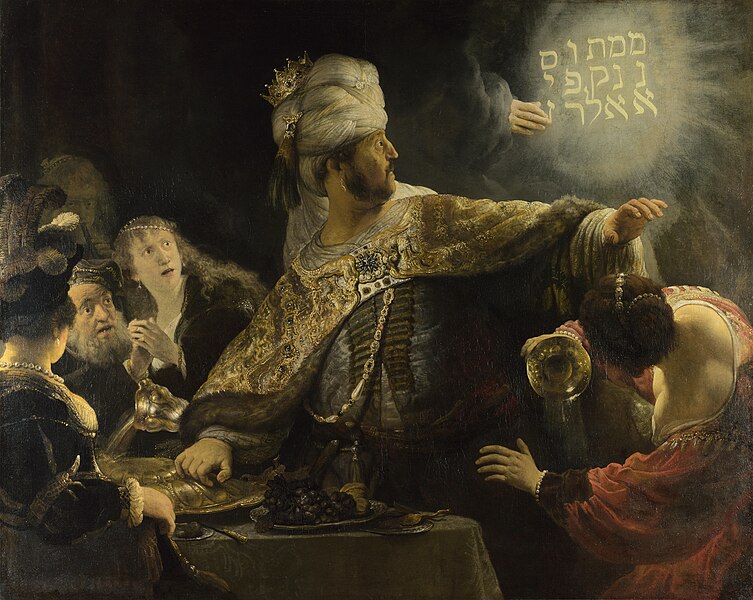
seldom heard a common oath when God's burning finger has been laid on the ship; when His "Menne, Mene, Tekel, Upharsin" has been woven into the shrouds and the cordage.
The phrase is from the book of Daniel, which reads:
And this is the inscription that was written: MENE, MENE, TEKEL, UPHARSIN.
This is the interpretation of each word. MENE: God has numbered your kingdom, and finished it;
TEKEL: You have been weighed in the balances, and found wanting;
PERES: Your kingdom has been divided, and given to the Medes and Persians.
In Daniel, God writes these words on the wall at a banquet at Belshazzar's Feast, where the nobles are sacreligiously toasting to other gods from Jewish sacrimental vessels. Note that Melville, or Ishmael, seems to have seen God send this message to whalers on more than one occassion. The art shows Rembrandt's depiction of the "writing on the wall" scene in Daniel, from the National Gallery.

During the silence, Queequeg's tatoos light up "like Satanic blue flames"; as the corposcants die, the Pequod is "wrapped in a pall". Finally, the silence is broken with Starbuck looking to Stubb for his read of the meaning of the corposcents, and while Stubb tries to read them as a good omen (as lit up spermacetti candles), Stubb quickly pleads for mercy on their souls as they light up once again. A moment of very dark humor at Stubb's expense.

At this point, Fedallah is lit up fitting out Ahab for the next coming strange ceremony; stepping on Fedallah, beside the Doubloon, Ahab gives a speech to the storm and the crew, telling of his prior wounding by lighting on these seas, his prior dismasting, when he "as a Persian once did worship". He calls to the fire, "Oh, thou clear spirit, of thy fire thou madest me, and like a true child of fire, I breathe it back to thee." This is the third great sermon, preached from on high, of the book, following Father Mapple's sermon in Nantucket and The Reverend Cook's sermon to the sharks. It is worthy of a close reading and comparison, though I will not do so now, since we are looking for a broad overview of this critical chapter.

Now, as you might imagine, Franklin with his Osiris myth has a field day with this chapter. There is no shortage of references that fit the myth including the anticipation of a pall for Ahab. However, other commentators, with different favorite myths, also see much in this chapter. Myths come together. In particular, many have focused on the Zoroastrian theme that sits right on the surface obvious to all: from the "Mene, Mene, Tekel, Upharsin" reference to Fedallah's role as Ahab's alter-boy and footstool to Ahab's statement that he "as a Persian once did worship". You will find fire imagery throughout this book, and fire is a key symbol in Zoroastrianism. The sun is a character all its own in Moby-Dick, whether beating down on poor Pip or floating in the upper half of the Doubloon. Here in "The Candles" is where you will best gain insight into the role of fire. Watch closely; it is a mighty force, and closely associated with Ahab. In Christian mythology, first is most often associated with hell, but in Moby-Dick fire does not play so clear or simple a role.

Ahab's speech is answered by yet more lightning and flame, and, in particular, the corposcents now light up his harpoon, which sits on his boat, just as it has lit up the masts. The lighting of the harpoon is magnificent and awe-inspiring. The crew is completely panic stricken. References to "The Forge" and earlier chapters involving fire abound. And, at this critical moment, Starbuck knows what he must do: he tells Ahab, in no uncertain terms, that God is against him and it is time to set the sail for home or face God's wrath. As the crew comically prepares to set sails that have been shredded to rags, Ahab reminds them their oaths to hunt the Whale are binding, as is his. We end the chapter with all in terror, with Starbuck and Ahab opposed, and with the crew in dismay at Ahab's orders.

In unpacking this chapter, I would focus you on two truly exquisite strands, recognizing there are others: first, the pivot to a fast-paced action-adventure and the movement into the final part of the book is a masterful exercise in writerly craftsmenship; and, second, the way in which many different mythological strands are brought together is a phenomenal set-up for our grand finale, with first the drama among the sailors and then the chase of the White Whale. The Book of Daniel melds both Judaic/Old Testament and Persian/Parsee mythological streams; the use of fire sets up an opposition of Parsee/Pagan and Christian themes (watch all the pagans in this chapter: they each receive a mention); the Typhoon captures it all in the ancient Egyptian myth. Suddenly, Ahab's central role in each different mythology seems to be coming together, even though the role he plays in each does not seem to allign. Is this song contrapuntal? Is Ahab simultaneoulsy a hero of a Parsee, a God to the Egyptians, and a Blasphemous Rebel to the Jews?

Tuesday, February 7, 2012

The Song of the Typhoon: First Verse


When first we meet Ishmael ashore, and we learn of his plans to escape the damp, drizzly November of his soul by going to sea, Melville graces us with some twenty beautifully wrought witty and easily read chapters. Then, we begin drifting asea, and things get strange, turgid, and considerably slower. For almost a hundred chapters, we timelessly drift, learning of whales and whaling as one after another whale's spout goes red as the whale turns. Other boats are met and other characters emerge as Melville encourages our speculation, prepares us for what is to come, and waxes philosophical. There is a sea-rhythm to it all. We sail towards South America, cross the Atlantic to the horn of Africa, and cruise through the Indian ocean. Passing the west of Australia, we cross into Asian waters at the Sunda Straight, sail the South China Sea, and enter the Pacific just south of Taiwan. We have passed every continent, save only Europe, though on these waters we have met one set of Europeans after another.

But, after entering the Pacific and heading for the Japanese hunting grounds, the pace quickens and the intensity builds. In "The Candles", St. Elmo's Fire lights up the boat's masts as we turn south toward the Equator and a typhoon hits. With all the drama and charged meanings of this chapter, as signs and signals literally light up around us, we enter a very new, different and exciting part of this book.

"The Candles" is packed. The pace now is that of a page-turner, the language pushes us forward, and the form is dramatic. Let us unpack this chapter a bit.

"Warmest climes but nurse the cruellest fangs" begins the chapter; "[s]o, too, it is, that in these resplendent Japanese seas the mariner encounters the direst of all storms, the Typhoon." The Pequod enters a Typhoon, its masts are shorn of sail, and thunder and lightening blaze about, showing the rag-tattered masts in profile. This is a stormy setting, remiscent of the storm that hit in the first act of our dramatic chapters, in "Forecastle - Midnight", when Pip and his tambourine were introduced to us. The storm, the "Typhoon" with a capital "T", has been read as repleat with meaning, as a storm demonstrating divine intelligence, for in this chapter, besides bearing that capital "T" name, it will respond to the actions of the crew. Here is the chapter where Franklin's reading of Ahab as the personification of the Osiris/Typhoon myth of ancient Egypt rings most true.

Once the stage's background is set and our storm is upon us, the characters enter: Starbuck on the Quarterdeck, attempting to contain the damage, Flask and Stubb before him, vainly securing the boats. Vainly because, our storm-with-a-will sends a sea to crash Ahab's whale-boat, in the very place where Ahab stands. Stubb laughs, tells Starbuck the sea will have its way, and sings a song for us, with a refrain "Such a funny, sporty, gamy jesty, joky, hoky-poky lad, is the Ocean, oh!" Stubb is steeling his will with song; the fact is, he is frightened to hell by the storm's power.

Starbuck, however, reads the storm, and understands its will. To Stubb's song, we get a grand line from Starbuck: "let the Typhoon sign, and strike the harp here in our rigging". The harp has sung in just one other place in the book: right after Ahab blesses his harpoon in pagan blood, he attaches the harpoon to a rope and makes it hum "like a harp-spring" in "The Forge". The exchange between Stubb and Starbuck here focuses on music and bravery, but note throughout the references to other chapters: Stubb talks of "singing the doxology", and the doxology is likewise referenced in "Fast-and-Loose Fish" as the song sung by the victor making fast a fish another had harpooned but left loose. As a pivotal chapter, you will find many strands of the story, many references, pulled together here. Expect this to continue in these fast-paced final chapters. Also note the changes to the sense of humor, which becomes much more gallows humor in its bent; the slapstick abates as we hit hight drama, and the humor takes on deadly irony.

As Starbuck reveals to us, the rapt audience, that the storm will turn fair if they turn for home, but will continue to hammer them if they instead head for the Line and Moby-Dick; at this moment, Ahab appears as a disembodied and unintelligible voice in the dark; finally, when asked who is there, he answers, mid-Typhoon, "Old Thunder!" Ahab identifies with the storm and embraces the very typhoon that is assualting them.

What have we so far to our drama: a storm with a will, a crew whose leader reads the signs in the storm, but whose other members are simply terrorized, and a captain who embraces the storm and its terror. Reading this with the Osiris myth, we are approaching the time of Osiris' dismembering by Typhoon, before Osiris wanders the earth in his coffin for six months, in a natural, eternal, and recurring progression.

This is the first verse of the Song of the Typhoon; in our second verse, the next posting, the stage, with Ahab on it, will be reset slightly as we get a short scientific discussion of boats, lightning, and lightning rods, and following this, the corposcants, or St. Elmo's Fire, will appear, and Ahab will take center stage from Stubb and Starbuck.

Monday, February 6, 2012

True Religion

"The Whale Watch", chapter 117, is, to my way of thinking, the single most devoutly religious chapter in this book filled with every religion born of Babel. After a day in which four whales were killed, far apart around the boat, Ahab and Fedallah (and their crew, but they are silent) float all night by a dead whale that they could not get back to the boat during the day. As the lamp casts its glow across midnight seas, Fedallah provides Ahab with a prophesy, a prophesy that we and Fedallah know to be grim, but that cheers Ahab:
"But I said, old man, that ere thou couldst die on this voyage, two hearses must verily be seen by thee on the sea; the first not made by mortal hands; and the visible wood of the last one must be grown in America."

"Aye, aye! a strange sight that, Parsee: - a hearse and its plumes floating over the ocean with the waves for the pall-bearers. Ha! Such a sight we shall not soon see."

"Believe it or not, thou canst not die till it be seen, old man."

"And what was that saying about thyself?"

"Though it come to the last, I shall still go before thee thy pilot."

"And when thou art so gone before - if that ever befall - then ere I can follow, thou must still appear to me, to pilot me still? - Was it not so? Well, then, did I believe all ye say, oh my pilot! I have here two pledges that I shall yet slay Moby Dick and survive it."

"Take another pledge, old man, said the Parsee, as his eyes lighted up like fire-flies in the gloom, - Hemp only can kill thee."

"The gallows, ye mean. - I am immortal then, on land and on sea," cried Ahab, with a laugh of derision; - "Immortal on land and on sea!"

Melville casts no doubt or ridicule on the prophesy; he does not even color it. Where other prophesies are made, as with Elijah, they are delivered with more than a touch of madness. Where other outrageous, difficult to verify statements are made, whether regarding the swallowing of Jonah or the chance of meeting up with the same whale twice, we get some discourse attempting to explain, justify or even just gild the extraordinary statement. This is bare, dramatic, and, most of all, true to what will occur.

Only here, in the words of this Zoroastrian, in the dark of night, lit only by a bit of oil and Fedallah's eyes, do we find true and unquestioned prophesy. Is this Melville's Pauline moment?

Thursday, February 2, 2012

Of Ishmael and Cetacean Foreskin


In earlier posts, I looked at Melville's use of the Egyptian myth of Osiris, in which Osiris is, like Ahab, dismembered by Typhon each year and then reborn, and the Hindu snake sacrifice myth in the "Ramadan" chapter, where the devout sage is ridiculed and mocked while carrying out a vow of silence. We have also looked at the Old Testament myths of Job and Jonah, preached through Christian authority. But we would be remiss if we did not delve more into more purely classical and Hebraic mythology.

In an article in Poetics Today (1998), Elisa New rereads Moby-Dick as critically focused on the conflict between Ishmael, whom she sees as an Hebraic scribe and the hero of the story, and Ahab, whom she sees as the flawed and anti-heroic voice of Hellenism and, in particular, of Pauline Platonism, a sort of angry Emerson in a toga. Ishmael, forever classifying, forever spewing legalisms, becames a wise Rabbinical sub-sub authoring a story that is a new Deuteronomy and a new Ecclesiatics, upholding the power and logic of the Word. Ahab, forever soliquizing, is the embodiment of a Christian/Hellenic spirit which wishes to embrace, conquer, and unify the very essence of the world. Ahab is St. Paul to Ishmael's Moses. Ishmael lives; Ahab dies.

New's reading grounds itself on a number of chapters she sees as the ultimate expression of "Ishmaelic scribalism", "Cetology" and "Fast and Loose Fish" among them, contrasted with a handful of chapters she finds deeply imbued with Hellenism: most prominently "The Cassock". In "The Cassock", a mincer cuts thin sheets of the blubber to feed into the flames of the try-works while encased in protective clothing crafted from the whale's penis skin, and New quotes the chapter:
"Bible Leaves! Bible Leaves!" This is the invariable cry from the mates to the mincer. It enjoins him to be careful, and cut his work into as thin slices as possible, inasmuch as by doing so the business of boiling out the oil is much accelerated, and its quantity considerably increased, perhaps increasing its quality.

Here is what she makes of it:
Melville's caustic allusion to "Bible Leaves!" makes it ambly clear that his mincer is a satirized minister. Traducing the materiality and history of the world's body in pursuit of its perfect spirit, this cassocked divine is one of Melville's many figures of a sacrificial and deadly Christian Hellenism, whose essentialist legacy Melville opposes with all the textual resources he can marshal. In another context, the analogy between the rendering of whale fat and the extraction of essence from Scripture might seem merely playful....This tableau of the tireless priest feeding leave to the fire and working, moreover, in an apron fashioned from the whale's own stupendous penis is calculated to elicit laughter.

There is indeed something here in her quote and analysis; the whale oil as essence, the giver of light; the humor of a cassocked mincer dressed in a penis feeding the Bible to hellfire; the send up of preachers and their hellfire rants; the intermixture of the demonic and the sacred.

But, somehow, New, as earnestly scholastic as any sub-sub, boils down the whole book into a single conflict between Hebrews and Christians/Greeks; she peels away the chapters to reveal in them her own most favored and most despised mythologies, and in so doing, gives the role of sacred law-giver and true superhero to Ishmael. She even identifies the Hebrews as the winners; the book becomes an anti-Platonic diatribe.

While it is good to see Ishmael raised up to such heights rather than in his usual role as the mere Bard of the two great characters of Ahab and Moby-Dick, a sort of Cetacean side-kick, I can not help but find this approach, well, sort of essentialist and Hellenistic of her. Come now. We can't read out the Hindus and Egyptians. More is afoot.

Tuesday, January 31, 2012

The Voice of the Whale

Throughout Moby-Dick, we look at Whales from many perspectives, considering their classification, the function of a whale's body, the whale's phrenology, the uses of various body parts, from blubber to skelaton, hide, muscle and brain, the history of whale hunting, the taste, and many more, too numerous to usefully catalog. We try to understand what The Whale is to Ahab, and what it is to Ishmael. Melville teases us throughout, however, with our failures of knowledge and the limitations of each perspective.

In the chapter, "The Sphynx", Melville very nicely has Ahab summarize the frustrations of our limitations, and highlights the one perspective we will not get: the whale's own:
"Speak, thou vast and venerable head," muttered Ahab, "which, though ungarnished with a beard, yet here and there lookest hoary with mosses; speak, mighty head, and tell us the secret thing that is in thee. Of all divers, thou hast dived the deepest. That head upon which the upper sun now gleams, has moved amid this world's foundations. Where unrecorded names and navies rust, and untold hopes and anchors rot; where in her murderous hold this frigate earth is ballasted with bones of millions of the drowned; there, in that awful water-land, there was thy most familiar home. Thou hast been where bell or diver never went; hast slept by many a sailor's side, where sleepless mothers would give their lives to lay them down. Thou saw'st the locked lovers when leaping from their flaming ship; heart to heart they sank beneath the exulting wave; true to each other, when heaven seemed false to them. Thou saw'st the murdered mate when tossed by pirates from the midnight deck; for hours he fell into the deeper midnight of the insatiate maw; and his murderers still sailed on unharmed - while swift lightnings shivered the neighboring ship that would have borne a righteous husband to outstretched, longing arms. O head! thou hast seen enough to split the planets and make an infidel of Abraham, and not one syllable is thine!"

Is the whale a divinity? Is the whale endowed with godlike power, the power of omnipresence, the power of life and death? Or is the whale simply the faceless, voiceless and ever-distant observer of history? Mid-way through the book, in a chapter that serves as a bit of a finale to the gory chapters of the cutting in and dissection of the whale (we will revisit the dissected whale and its parts later, as they are fed to the try-pots and the oil is rendered), Melville wishes only to heighten our questions, and brings Ahab on the stage to ensure we are paying attention.

Tuesday, January 17, 2012

The Stage, The Storm; Enter Pip


I have a few thoughts today on several of the most critical and dramatic chapteers of Moby-Dick: the dramatic chapters beginning with "The Quarter-Deck" and ending with Pip's speech as the tempest breaks in "Midnight - Forecastle". There is an obvious and radical technique interjected here, where Melville begins each chapter with stage directions and very explicitly frames them as a dramatic production. This is a work-within-a-work, a framed story, in the tradition of the Thousand-and-one-Nights, the Panchatantra, The Canterbury Tales and Shakespeare's Hamlet and Midsummer Night's Dream.

Now, there is little I can say here that you cannot read. It may be helpful to know that there are four such dramatic sequences in Moby-Dick; the first one, a more subtle one that launches into the play format mid-way through the chapter, is "Enter Ahab; to him Stubb". The next is a short, one chapter interlude, "Ahab and the Carpenter", surrounded by other dialogue heavy but not fully dramatic chapters. The final one is the long sequence that begins during "The Candle" and ends with "The Cabin" immediately prior to the final chase scenes. These dramatic chapters are of a piece, and highlights a play among a subset of the human characters in the book.

Also, look carefully at the key curtain scenes. Perhaps the only character whose entrance is built up nearly to the same degree as Ahab and Moby-Dick is Pip; he is first introduced, silently, in Knights and Squires, and he receives the curtain speech at the close of this critical act.

One of the elements of the play-within-a-novel technique that is so effective is that Melville can foreshadow far more effectively and with more subtlety than the average playwright; the novelist elements beforehand introduce and color each of the characters when they show on the stage, giving them the depth of character that might not appear until the third act at the very point where the curtain rises.

The contrast between these chapters and what comes before also heightens the drama: we move from our yarn before the fireplace with Ishmael to find the fireplace pulled back and a sudden congregation of the players that were heretofore just words in Ishmael's mouth in front of and above us on a stage, suddenly larger, better lit, and more colorful than we might have imagined them, and, in each case, no longer mute. Our prior intermediary, Ishmael, drops away entirely and we commune with them directly; he may be sitting in the back of the audience with us, but he takes on the former muteness of many of the characters. We no longer suspend disbelief: we are to believe.

Now, let's take a quick look at the curtain speech for this act, delivered as a storm breaks (the image above is Turner's "Tempest") after a rowdy, drunken, multi-cultural dance act, perhaps the single most pagan moment of the whole pagan book:

Jollies? Lord help such jollies! Crish, crash! there goes the jib-stay! Blang-whang! God! Duck lower, Pip, here comes the royal yard! It's worse than being in the whirled woods, the last day of the year; Who'd go climbing after chestnuts now? But there they go, all cursing, and here I don't. Fine prospects to 'em; they're on the road to heaven. Hold on hard! Jimmini, what a squall! But those chaps there are worse yet - they are your white squalls, they. White squalls? white whale, shirr! shirr! Here have I heard all their chat just now, and the white whale - shirr! shirr! - but spoken of once! and only this evening - it makes me jingle all over like my tambourine - that anaconda of an old man swore 'em in to hunt him! Oh, thou big white God aloft there somewhere in yon darkness, have mercy on this small black boy down here; preserve him from all men that have no bowels to feel fear!


Is Pip's speech the speech of the fool or the tragic hero? Or the speech of a fool delivered by a tragic hero? Watch Pip.

Monday, January 16, 2012

Heed Well, ye Pantheists!

Melville, realizing that he made extraordinary demands on the reader in that Cetology chapter, generously rewards the reader afterwards: after a short interlude contemplating Ahab's multi-tiered crown in the "Specksnyder", we get some good old-fashioned slapstick in "The Cabin-Table" and a blissful reverie in "The Mast Head".

The Cabin-Table continues some of the formal innovations that began being introduced as we left shore. Now, Ishmael's voice is wavering, and a third-person narrator seems to be trying to edge his way into the book. Suddenly, we have scenes told by Ishmael where he is not present. Melville begins the transition carefully, almost imperceptibly, but it will become more pronounced quickly.

The Cabin-Table, like many chapters, easily splits in two, with the first half emphasizing Ahab's royal table, which is carried out each day with great ceremony and deference, much to the dismay of the lesser nobles who serve Ahab. Watch carefully the language here, and remember throughout that at least two of the harpooners have already been identified as royals in their own right. Part two of the chapter features the more lively and democratic table of the harpooners, one which none-the-less plays havoc with the servants. Here is where the real slapstick occurs, as the poor Dough-Boy finds himself at the mercy of hungry savages who gleefully salivate over the prospects of having the Dough-Boy himself on their plate. The bifurcated chapters beg for comparison (indeed, Melville introduces the second part with the words "in strange contrast"). When comparing, expect a richness of ironies almost folding in on themselves. The democrats are baronial while the nobles suffer privation.

This is a rudely comic chapter for Ahab to play a role in, though Ahab does not speak and the true comedy is contrasted with his own mute and formal table. Watch the closing description of Ahab in this chapter, as telling and interesting a description as you'll get (and you will get many!):

Though nominally included in the census of Christendom, he was still an alien to it. He lived in the world, as the last of the Grisly Bears lived in settled Missouri. And as when Spring and Summer had departed, that wild Logan of the woods, burying himself in the hollow of a tree, lived out the winter there, sucking his own paws; so, in his inclement, howling old age, Ahab's soul, shut up in the caved trunk of his body, there fed upon the sullen paws of its gloom!


We do not stay long in the sullen paws of a gloomy soul, however, we rise quickly in the next chapter to the height over which the great ocean can be surveyed. Here, let us start from the last and weighty language of this chapter (note how often the last language is the most important of the drama), where Ishmael addresses himself to the gently swaying mystics atop the mast-heads:

There is no life in thee, now, except that rocking life imparted by a gently rolling ship; by her, borrowed from the sea; by the sea, from the inscrutable tides of God. But while this sleep, this dream is on ye, move your foot or hand an inch; slip your hold at all; and your identity comes back in horror. Over Descartian vortices you hover. And perhaps, at mid-day, in the fairest weather, with one half-throttled shriek you drop through that transparent air into the summer sea, no more to rise for ever. Heed it well, ye Pantheists!


That is wonderful, lulling and rhythmic language, but there references are themselves worthy of ponder. Let yourself be mesmerized as you read, but go back and scratch your head a bit when you're done.

The phrasing is fraught with religion, history and mythology. Read in it claims of ancient Egyptian primacy, and the genuflections to monastics and early Christians and Rhodes; the references to heros of many lands (Washington, Napolean, Nelson); progress from there to historians and fablists; and finally, arive at the philosophers and poets. Like the man on the mast head, blissfully bobbing with his mind adrift, we survey a broad expanse here before reaching the end, where we are reminded that there are dangers to our reverie. Reveries interfere with commerce; indeed, they even threaten survival.

Yet, it's been a pleasant read, and Melville's set up a great transition from one daring and difficult chapter in Cetology to a series of truly unexpected chapters to follow from here.

Thursday, January 12, 2012

The Pipe


The Pipe is a short chapter. Let us quote it in full:

When Stubb had departed, Ahab stood for a while leaning over the bulwarks; and then, as had been usual with him of late, calling a sailor of the watch, he sent him below for his ivory stool, and also his pipe. Lighting the pipe at the binnacle lamp [pictured, left] and planting the stool on the weather side of the deck, he sat and smoked.

In old Norse times, the thrones of the sea-loving Danish kings were fabricated, saith tradition, of the tusks of the Narwhale. How could one look at Ahab then, seated on that tripod of bones, without bethinking him of the royalty it symbolized? For a Khan of the plank, and a king of the sea, and a great lord of Leviathans was Ahab.

Some moments passed, during which the thick vapor came from his mouth in quick and constant puffs, which blew back again into his face. "How now," he soliloquized at last, withdrawing the tube, "this smoking no longer soothes. Oh, my pipe! hard must it go with me if thy charm be gone! Here have I been unconsciously toiling, not pleasuring, - aye, and ignorantly smoking to windward all the while; to windward, and with such nervous whiffs, as if, like the dying whale, my final jets were the strongest and fullest of trouble. What business have I with this pipe? This thing that is meant for sereneness, to send up mild white vapors among mild white hairs, not among torn iron-grey locks like mine. I'll smoke no more - "

He tossed the still lighted pipe into the sea. The fire hissed in the waves; the same instant the ship shot by the bubble the sinking pipe made. With slouched hat, Ahab lurchingly paced the planks.


Note that the first part of this chapter is quite explicit. Ahab is sitting on a whale-ivory stool, and Ishmael is talking about the symbolism of Ahab sitting there. We don't have to guess that there is a symbol at play - Melville says as much.

Now look at the second part of the chapter. Well, something is happening with this pipe. There is whiteness there, in the smoke, in the hair, and oh how we know white means something here; we are approaching a long discourse on whiteness. More than that, there is fire here, and Ahab will be associated with fire over and over in this book. Ahab is renouncing a firey pipe, but one he gets no pleasure from any more. He seems done with the white, the mildness, and the fire. Thers is regret in the air.

Ah, now there are symbols afoot, and here Melville lets us guess! But, beyond symbols, there is a drama, a short, intense drama of a man having just had hard words with his officers looking for a smoke and a break; he is a restive, somewhat troubled man who can find no satisfaction. Ah, Thomas Mann, can you offer him a Maria Mancini?

This chapter is a wonderful microcosmic read of Melville's method. It is slim, it is dramatic, and one can light one's pipe and think on it for no short period of time. After that thought, you may still not be fully satisfied - blame it on the pipe and toss it aside if you must.

Tuesday, December 20, 2011

Comical Obligations

Moby Dick is about religion, that much is certain. Whether or not it is religious or anti-religious or just chewing on the fat of religion is a question I leave to each reader. Melville's own religion is a bit of cypher, despite much research on the subject. I trust the difficulty researchers have in figuring out his faith reflects Melville's own struggle with the task, and perhaps some of this endless going-on over six hundred pages is all just misery seeking company.

In Clarel, Melville writes of different religious impulses that Clarel first "marks", then is "awed" by ("Buddha, the Mongolian Fo, or Indian Saviour"), and then waxes on the "intersympathy of creeds" that confuses and entices the boy. But Melville then goes on to address not the sympathy but the hostility between creeds.

Are creeds hostile or sympathetic? This theme and question facscinate, but I find Moby Dick to tend toward the sympathetic, with much more attention to universal struggles of all creeds than to the particularities that may divide them. Still, there's stuggle enough in the book: don your favorite protective gear, grab your weapon of choice, and keep your guard up.

As a little aid to wending through the book, let's start by simply identifying the particular creeds that have adherants in the story. It's also a good chance to take notice of the main players (other than, of course, the Whale):

Ishmael: Presbyterian
Queequeq: Some form of south sea Pagan
Ahab, Peleg and Bildad, Starbuck: Quaker
Father Mapple: Congregationalist
Tashtego: Native American pagan
Dagoo: African pagan
Fedallah: Zoroastrian

I don't see Pip's, Flask's or Stubb's denomination identified quickly; we'll see if we come across them as we read. There will be more anon on each of these characters.

This is a small little beginning of a reading aid, and I will try to also focus on some of the places and discussions relevant to the interdenominational discussion, but it is good to keep each character's faith in mind throughout.

As Ishmael says in "The Ramadan" chapter:
I cherish the greatest respect towards everybody's religious obligations, never mind how comical, and could not find it in my heart to undervalue even a congregation of ants worshipping a toad-stool; or those other creatures in certain parts of our earth, who with a degree of footmanism quite unprecedented in other planets, bow down before the torso of a deceased landed proprietor merely on account of the inordinate possessions yet owned and rented in his name.

And much of this book is about cherishing the comical obligations of varied religions.

By the way, who is that Mongolian Fo, anyways?

Monday, December 19, 2011

Enter Ahab

Enter Ahab. It is the name of the first chapter where Ahab speaks (following a chapter which bears his name in which he does not speak). It is also a stage direction that will appear again. Enter Ahab. Ahab more than any other character is a player on the stage.

Before Ahab appears, Ishamel learns of him from the boat's owners, gossips of him, speculates about him, and is even warned by a prophet, Elijah, about him. Before he speaks, the boat has been chosen, the sails set, and the ocean reached. As grand an entrance as it is, it is still only a way-station to higher points in the drama.

Many of Melville's minor characters - Fedallah, Pip, even Starbuck - serve as foils to Ahab, helping define him and magnify him. There are two characters at the core of this book - Ahab and the Whale, and to truly explore Ahab's character is to get to the heart of the book. We can only just begin here.

As an introduction to Ahab and Melville's painting of him, let's look at a just one great central moment for Ahab, one that drives right at his character: the forging of the harpoon that Ahab intends to use to kill the whale.

Fashioned at last into an arrowy shape, and welded by Perth to the shank, the steel soon pointed the end of the iron; and as the blacksmith was about giving the barbs their final heat, prior to tempering them, he cried to Ahab to place the water-cask near.

"No, no - no water for that; I want it of the true death-temper. Ahoy, there! Tashtego, Queequeg, Daggoo! What say ye, pagans! Will ye give me as much blood as will cover this barb?" holding it high up. A cluster of dark nods replied, Yes. Three punctures were made in the heathen flesh, and the White Whale's barbs were then tempered.

"Ego non baptizo te in nomine patris, sed in nomine diaboli!" deliriously howled Ahab, as the malignant iron scorchingly devoured the baptismal blood.


The Latin translates to "I do not baptize in the name of the father, but of the devil!" Melville was inordinately fond of this line - a longer version ("Ego non baptizo te in nomine Patris et Filii et Spiritus Santi. - sed in nomine Diaboli") is found scribbled in the back of one of his Shakespeare volumes, and he wrote a letter to Hawthorne describing it as the "secret motto" of the book. But set aside what this passage might mean - we'll get there, but not for a long time. All we're interested in right now is Ahab the character and his presentation. What man should we prepare to meet?

Ahab is the central figure whenever he appears. Melville writes in short chapters, each a small tableau or drama, and if Ahab speaks in a chapter, expect him to be the focus of that chapter. His speech is always heavily laden with salty sailor and "thees" and "thous" Quaker, and there is often a significant contrast in tone between Ahab's speech patterns and those with whom he speaks, whether the plain-spoken wry Ishamel or the level-headed rationalist Starbucks. This helps him stand out. As noted earlier, there is often stage direction inserted to accompany him.

After his build up and grand entrance, Ahab will almost inevitably deliver one or more absolutely killer lines. "Ego non baptizo te in nomine patris, sed in nomine diaboli!" The great lines are often heavily laden, referential and suggestive: by turns Melville will suggest Marlowe's Faust, Milton's Satan, or Shakespeare's Edmund. As you read, stop and admire the art of the framing of Ahab: all these techniques, all this build up, and all these wonderful lines are what make him one of the most powerful characters in literature. These one-liners are the greater part of the sheer bombast in Moby Dick. All too often, critics remember them as the whole book, and forget the less dramatic, contemplative, philosophical and humorous stretches that make up most of the work.

Outside of the chapters where Ahab is central, most chapters will fit into two other types: chapters that focus elsewhere but lead to a discussion of Ahab or flesh out some aspect of Ahab, and chapters that generally take a philosophical deep dive, often focused on the Whale or whaling, wholly omitting Ahab.

The chapter entitled Moby Dick, for example, is one of the first category, focusing first on the whale, but finally leading to Ahab and his key mates and crew:

Here, then, was this grey- headed, ungodly old man, chasing with curses a Job's whale round the world, at the head of a crew, too, chiefly made up of mongrel renegades, and castaways, and cannibals -- morally enfeebled also, by the incompetence of mere unaided virtue or right- mindedness in Starbuck, the invulnerable jollity of indifference and recklessness in Stubb, and the pervading mediocrity in Flask. Such a crew, so officered, seemed specially picked and packed by some infernal fatality to help him to his monomaniac revenge.


For the most part, however, Ahab recedes into the background for the long less dramatic parts of the book; these are the territory of the whale and whaling, and of we mere mortals who concern ourselves with them. When Melville turns contemplative, Ahab and his Latin and his thees and thous step aside.